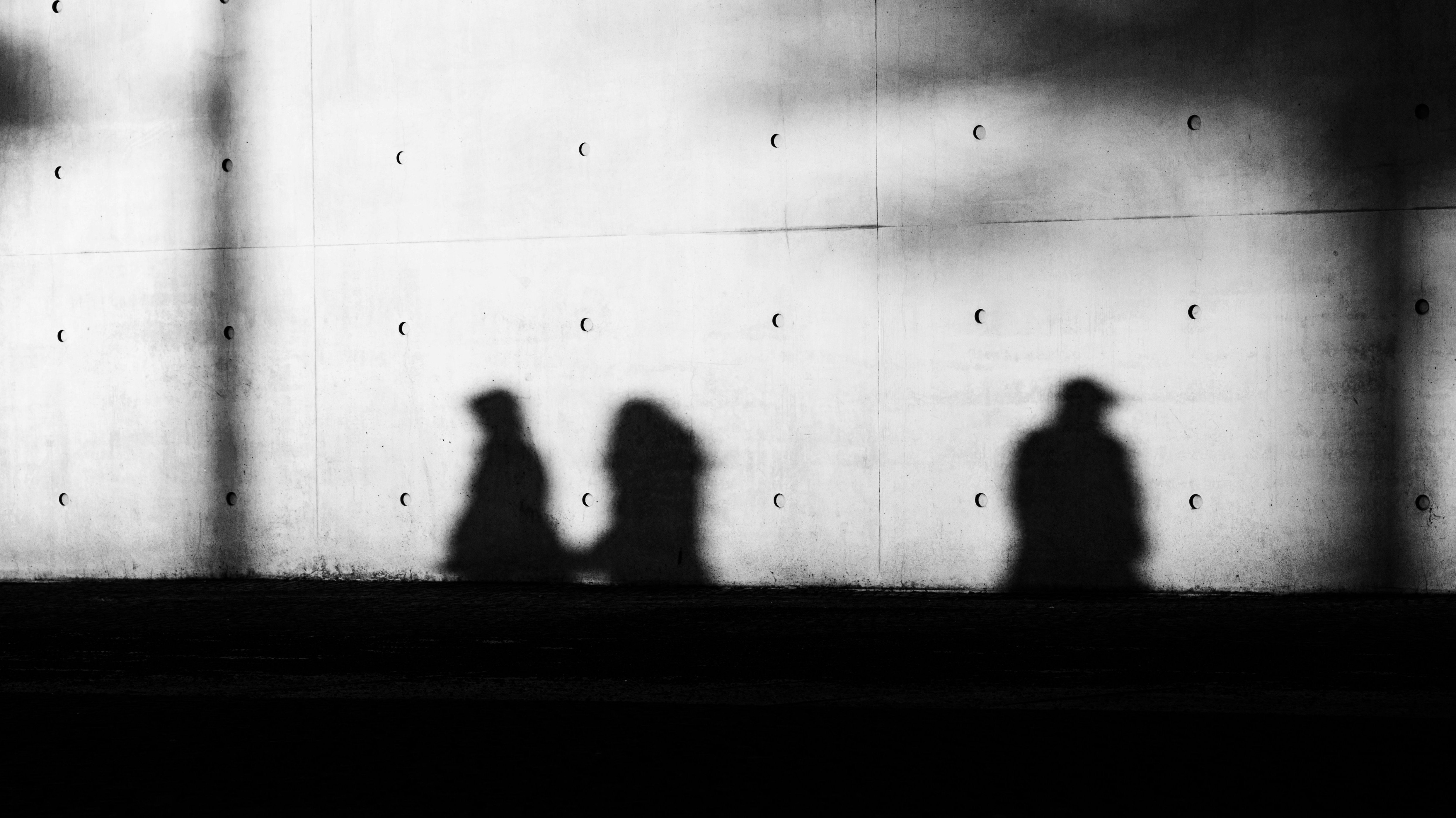
The Caretaker Made Me Do It by John Mann
Waiting Room
Light stabs my eyes. I do not feel as if I am waking, nor as if I have my eyes closed. Open or shut, the world stays smudged, like waking from a deep sleep.
A heavy pressure gathers on my chest. The cubicle is washed by the glow of the screen in front of me. A weight. Then nothing for a while. Voices. Nothing again. Figures huddle nearby, and there is a murmur. I can hear some words, but they are hard to follow. Someone says heart attack. The words arrive, then arrive again. A paramedic says it was quick, that there was nothing they could do. One of them mentions I have been dead for a while.
Are they talking about me? I can’t be dead. The word arrives, then arrives again. Dead. I look around and seem to be able to focus better. Faces blur into bodies. Bodies press close. They seem indistinguishable as they form lines. The air smells faintly of rain on copper, a clean smell with a metallic edge. Desks wait ahead with figures in pale tunics. Beyond them, arches shimmer, there and not there.
I try to ask where we are, but the effort drains me before I can find my voice. I let the line carry me instead. Is this the DMV? The thought feels childish and wrong, but it sticks.
Around me, the others are frozen in the moments of their exits. A woman holds her ribs, sobbing without sound. A boy in a soccer jersey blinks rapidly, the mud on his knees already beginning to flake. An older man steadies a hand taped to his chest, his hospital bracelet dangling loose from a thin wrist. A tall figure nearby smells of smoke, his hair singed at the edges. Somewhere, an infant fusses, but the sound flattens instantly, as if the heavy air simply swallows it whole.
Some of these people cannot be alive, not with those injuries. What do you call people who aren’t alive? Probably not people. I try to run and nothing moves. The line moves me along. Panic rises, then stalls. I count breaths. I tell myself to wait for proof, then remember I already heard it.
I am forty-three. I was forty-three, and I thought there would be more time. Time flips past in little frames, like one of those old flipbooks. I start recalling moments. Joanie asking for my help and I not answering. Dad’s last call, which I ignored. Just like a sketchbook full of starts or failed moments. Each memory adds a small weight to the ache that does not leave.
Maybe more awake, I can hear more crying, sobbing, and words here and there. “Oh my…” and, after some effort, “God.” Others just utter a broken “sorry” before they break into sobbing. Many others just say something that probably is “why?”
It seems most here are remembering our lives. I still can’t say anything. My eyes have an easier time jumping around, and I start looking at people more carefully. They are wearing a collage of clothes that spans the ages: suits of armor and other military uniforms, and old-fashioned suits. There doesn’t seem to be any rhythm to what they wear. Some are robed or in habits, others wear simple puritan clothes. These all gasp out a muffled, broken chant.
They must have been here for centuries. Will I have to remain here that long? If I could move, I would probably fall to the ground. Still, I remain standing, drifting along. It’s not so much that the line moves forward as that some of those standing around just vanish. I never see them disappear; someone simply appears there, or the masses of people fill the void. I remember one of my high school teachers saying, “Nature abhors a vacuum.”
“Lost in thought, are you?”
A man is beside me. I did not see him arrive. His face looks both young and old, features that seem new and worn at once.
“I think I am dead,” I say.
“Most here are. You are waiting to move forward.”
“They are in pain,” I say, looking around. “Shouldn’t someone help them?”
“You wait as you died until you are processed,” he says. His tone is gentle. It does not make it easier. “You look intact. How did you die?”
“Heart attack, I think.”
“Good,” he says. “Well, not for you, but it means you are more or less whole.” He glances toward someone who must have been in a terrible accident. “Come with me.”
“I cannot move.”
His hand touches my shoulder. My legs go slack, yet I do not fall. He is holding me.
I try to lift my arm to point at everyone, but it barely flutters. “I do not want to lose my place. Many seem to have been waiting for centuries. I will be here forever.”
“You will not lose it. Your place will wait. Besides, your position isn’t when you get looked at.” I look at him curiously, but he ignores me.
“Try a step,” he says.
I step. The air feels lighter, not right, but lighter. I do not know if this is a kindness or a test. He moves through rules as if they are curtains.
“This way,” he says, pointing toward a direction that looks like any other.
Cafeteria
Noise thins and then is gone. Even our steps forget how to echo. There is no doorway. One moment there are lines and arches and the overwhelming sensation of so many people, the next a warm lawn with stone steps and a wide old tree. Fruit hangs round and iridescent, colors I do not have names for. Groups sit and talk as if on break. No queues. No arches.
“Sit. You look ready to fold. Wait here while I get you something I shouldn’t be giving you, to steady you,” he says.
The stone is cool through my clothes. The ache in my chest is still there, not sharp now, just a steady thumbprint.
He returns with two metal-looking cups from a fountain where a golden liquid runs in a thin sheet. The surface in the cups holds light the way a cloud does.
“What is it?” I ask.
“Mercy,” he says, and hands me one. “Some here call it nectar.” He raises his cup to his mouth, wets his lips, and sets it down. The level does not change.
I drink. Warmth spreads and steadies. The pain loosens a notch. The panic lets go a little.
“It does not erase anything,” he says, as if answering a question I had not asked aloud. “It trims the edges while you are here. It’s usually not for you, but without it this chat would be uncomfortable for you.”
“You drink it too?”
“When it is busy,” he says. “We run lean this cycle.” He pauses, then seems to notice and corrects himself. “They run lean.”
“We,” I say.
He smiles without answering.
“What is this place? Purgatory?”
“If that word steadies you, use it.” He watches the fruit in the branches. The leaves move. The fruit holds steady. “I think of it as staging. You come to temper. When your number is called, you step. They name a door. You supply the name on the other side.”
“Heaven and hell?” I ask. The word God sits just behind my teeth and wants to be said.
“Those are doors some people need. Others do fine without doors.”
“Who calls the numbers?”
“You. Clerks. Intake. Names change. Work stays the same.”
“Who do they work for?”
“The seat above.”
“God,” I say.
His mouth shifts, a faint twinkle ghosting the edges of his eyes. “Or the idea of. There has been an administrator looking after things.”
“So, there is a supreme being. God, then,” I say.
“A caretaker, that is the word most of them use.” He sets his cup where the light breaks it into a rim of fire. “It keeps the hands-off blame.”
“That cannot be right. God is not an administrator. He is more than a caretaker.”
“Some say the Maker has not sat that chair since before chairs were a thing anyone knew.” He watches the cup as if it were ticking. “Others say otherwise.”
“What do you mean? God is gone?”
“The caretaker has looked after things since,” he says.
“If God left, how could He have written the Bible?” I ask.
“Writing came much later. There was no need for it in Eden,” he says. “People told stories to keep their balance. When ink arrived, the stories took on bones, set by hands that were present, not by a hand that had departed. People later called those writings sacred, the Bible, or God’s word,” he adds. “They helped them stand. The pages were written by those still here. The caretaker was good at leaving room for a silence to be named. People hear what they need when a silence has a name.” He lets the idea sit. I start playing with my cup as my mind goes wild. Only now do I notice some dents. Dents that weren’t there a moment ago. “He liked pranks. He nudged and watched the mischief people made in the name of those pages.” I’ve seen people do the worst things when the word on their lips sounds holy.
“Wait, Eden? Are you suggesting God has been missing since Eden, the creation?”
“He left when His creation did not follow His word. Adam was not to partake of the fruit of knowledge.” He gestures toward the fruit in the branches. My stare fixes on a swinging fruit. The fruit of knowledge! “When He left, Eden could not hold. The work continued on Earth.”
“Heaven’s chair isn’t a throne anymore,” he says. “It’s a desk. People have been arguing with a ghost for millennia while someone else kept the lights on. Since then, the caretaker has been the administrator of creation.”
“If not God, then an angel?”
“You could say that, but most angels were gone when He left.”
“Michael?”
“Most of the high angels were gone when He left,” he says. “The chair did not stay empty, but names are costumes or comfort.”
“Costumes for who?”
He lets the question sit. “Older names persist in the background. Names that describe a job more than a face.”
“Such as what names?”
“Accuser,” he says, and does not add more.
I sit with it. Dead, a line that moves without me, a chair that may be empty, a caretaker with older names. The lawn feels too gentle for the weight of the thought. Above us, one of the fruits lets go. It drops in a slow arc and vanishes the instant it touches the grass.
He does not press me. He lets the silence work. In the quiet I think of the last message from my father that I did not answer. I think of the sketchbook and all the half pages. I want to call someone, and there is no one to call. With each of these I feel the pang of my regret, though not as intensely as when in the queue.
He notices my flinching. “People here are to learn, and to come to terms. You need to realize that you were responsible for what you did in your life. People blame everything for their wrongdoings: their parents, the conditions, religion, the lack or excess of something, God, the devil, whatever. It was you, nothing else. Haven’t you done something you thought was good because you did it for yourself?”
An image flashes through my mind. “Gave a beggar some money to help him out.”
“Did you? Or was there another reason?” he asks.
“It was cold and I gave him a buck.”
“A full buck. And did that make any difference to either of you?” The memory of the event is sharper now. I was going to a dinner that cost a lot more. He glints as he notices me shuddering with discomfort. I take a sip, and that eases the pain.
“I was late and didn’t want to fuss. Had a nice steak dinner with my friends and felt the buck helped him.”
“So, you calmed your conscience with a handout that probably didn’t help him much. You chose the kind of help that asked the least of you. The caretaker only made the excuse easier to wear.”
I am about to interject when, across the grass, a soft bell passes. It is not a sound so much as a change in the air. A few people stand and drift toward a place that only shows itself when you look at it. The man watches them the way a lifeguard watches a pool.
“You said older names,” I say. “If I have to carry this, I need to know which one.” My mind races with options as I say this.
“Names are costumes,” he says again. “Intent is the body. Comfort fools crowds. Intent fools no one for long.”
“I understand,” I say. “I still need a name.”
He studies me, not unkindly, as if he is checking whether this will help or harm. “The one who keeps the system is exact. He plays with rules, and he likes watching what people do inside those rules. He argued that choices mean nothing if nothing resists them. Some call it the old paradox about an all-powerful and all-good God and the existence of evil.”
“That sounds like God,” I say. “My mother always said He worked in mysterious ways.”
He nods once. He does not look away from me. The surface of his cup has not lowered. “Not God.”
“Then who?” I ask.
“If you need the old name people fear, you already know it.”
The word comes out before I plan it. “The devil.”
He does not confirm. He does not deny. He chuckles. “Mysterious ways is one of his favorite pranks.”
Something like relief moves across his face and is gone. The tree gives a small creak, the sound a living thing makes when the wind changes.
I see him wince as he says, “The irony is that the caretaker enjoys chaos and breaking rules. Now he heads an infinitely large bureaucracy. He had to learn to play with the rules and the bureaucracy.”
“No,” I say. “God is goodness. The devil is evil. You’re saying evil runs things. It would explain the state of the world,” I add before I can stop myself. “It even fits the old paradox you named. I still can’t believe evil won.”
“That duality didn’t always exist. People built it, and the caretaker encouraged it. He loves watching you twist yourselves into justifications and arguments about good and evil. It isn’t a house divided,” he says. “Good and evil are just different ways of handling the silence. What’s left over, you color with whatever name you need.”
“The Maker left a pull toward the good in every soul,” he says. “It does not vanish. The one who keeps the system cannot remove it. He can press, distract, and reward convenience. He can widen rules so people can wander. Most still feel the pull. On many days that is enough. You need nothing more than a hint to see how far pettiness can go, yet most still stop short.”
“It has taken millennia to move the needle away from goodness. He relishes it when people think they are pious as they commit acts of hatred, are petty and cruel because God is on their side. We should go back in a moment,” he says. “The next group will start, and my shift ends when they move.” He catches himself, a look of disapproval crossing his face. “Their shift.”
“Why would the caretaker care about keeping this place running?”
He glances upward and chuckles. “He didn’t want to at first. It required too many clerks, but he had no choice. Eventually souls started to leak back and haunt their familiar places. It took us ages to clean up. I don’t think they’ve recovered them all yet.” He almost says we, and I see it in the flicker of his expression, but he doesn’t correct himself this time.
Another pang runs through me as I remember breaking my mother’s favorite vase. Her words sound like a prophecy after his: “The devil made you do that, John.”
“You said earlier that I would not lose my place. How do you know that?”
“Because you will not,” he says. Certain, like weather. “No authority. Just familiarity.” No one looks at him for long. When they do, their eyes slide away. A clerk glances up, then pretends to fix a form.
“What did you mean by noise?” I ask. “You said we stay until we can hear ourselves think without the noise.”
“The overlap,” he says. “Fear, regret, the words people swallow and the ones they shout. It collects. We are near it. We carry some. The drink helps it pass through.”
“You probably saw many pious people in line. Their religious beliefs didn’t allow them to come to terms with their life. Their dogma doesn’t allow them to rise above the noise. Actions aren’t what matter to move on. Even the most lethal warlord, like Genghis Khan, could deal with the noise of his life better. He saw himself as God’s weapon, but he still had the regrets of any person.”
He glances at my hands. “You carry a sketch that never found ink.”
“How do you know that?”
He does not answer.
“You feel what we feel,” I say.
“When I am nearby,” he says. He nods at my cup. “Another sip. Your heart is trying to convince you it still has work to do.”
I drink. The ache steps back another pace. Relief comes with a thin film of contentment that I do not entirely trust. The tree’s fruit seems closer now, as if the trunk breathed me forward.
“What are those fruits?” I ask.
“People give them many names,” he says. “They are not apples. You can make peace with that.”
“They are why this exists?” I gesture at the steps, the grass, the tree, the people with their cups and their tired voices.
“They are a reminder that knowing and being ready are not the same thing.”
“You talk like you were there,” I say.
“I talk like someone who listens.”
A cool draft passes through the space. A group stands, stretches, and drifts toward where a doorway might be if there were walls.
“How long do people stay?” I ask.
“As long as it takes to hear themselves think without the noise,” he says.
“Leaving people with only their thoughts and regrets seems cruel,” I say.
“It can feel that way,” he says. “Stillness is not punishment. It is where you hear yourself without the crowd. Once you accept what you did, then you might be ready to move on.”
“What happens after that?”
“You step. What you call the next place depends on what you expect to find.”
“That sounds like a trick.”
“It is a mirror. Mirrors are worse when you are tired.”
The name sits between us. I think of the lines and the arches. I think of how my place will not be lost, and how he knew that. I think of mercy that does not change the level in his cup.
“I should go back,” I say. My mind is spinning with our conversation. This stranger just shattered all my understanding of God, the devil, good, evil, and probably the meaning of life. As if I ever knew that.
“Your place will be there,” he says, and it feels like a promise he gives often.
“Will I see you again?”
“If you keep asking questions that cost you something.” He rests his hand on my shoulder.
I’m just starting to say, “Who are you really?” when the warmth fades. The light tilts. The grass slides away. The sound of lines breathing together returns like surf, and one of the arches ahead briefly takes on the same color as the drink.
This reception once seemed neutral and grandiose; now it looks sinister. The shimmering arches remain, but they feel indifferent. No longer comforting. The clerks look distorted, not quite human. Their tunics are sullied, and the desks are in disrepair.
The ache in my chest returns to its post. A woman’s sob tightens into silence, as if the air remembers to hush again. I can still hear people saying “oh God.” I want to scream back, “The caretaker made you do it,” but only a gasp comes out. Then I realize this, like so many others, is just another excuse to deflect the blame from ourselves. As I think this, it feels like a weight vanishes.
As if every failed sketch I ever started suddenly settles on my shoulders, I understand that nothing is as I thought. Life now seems unkinder.