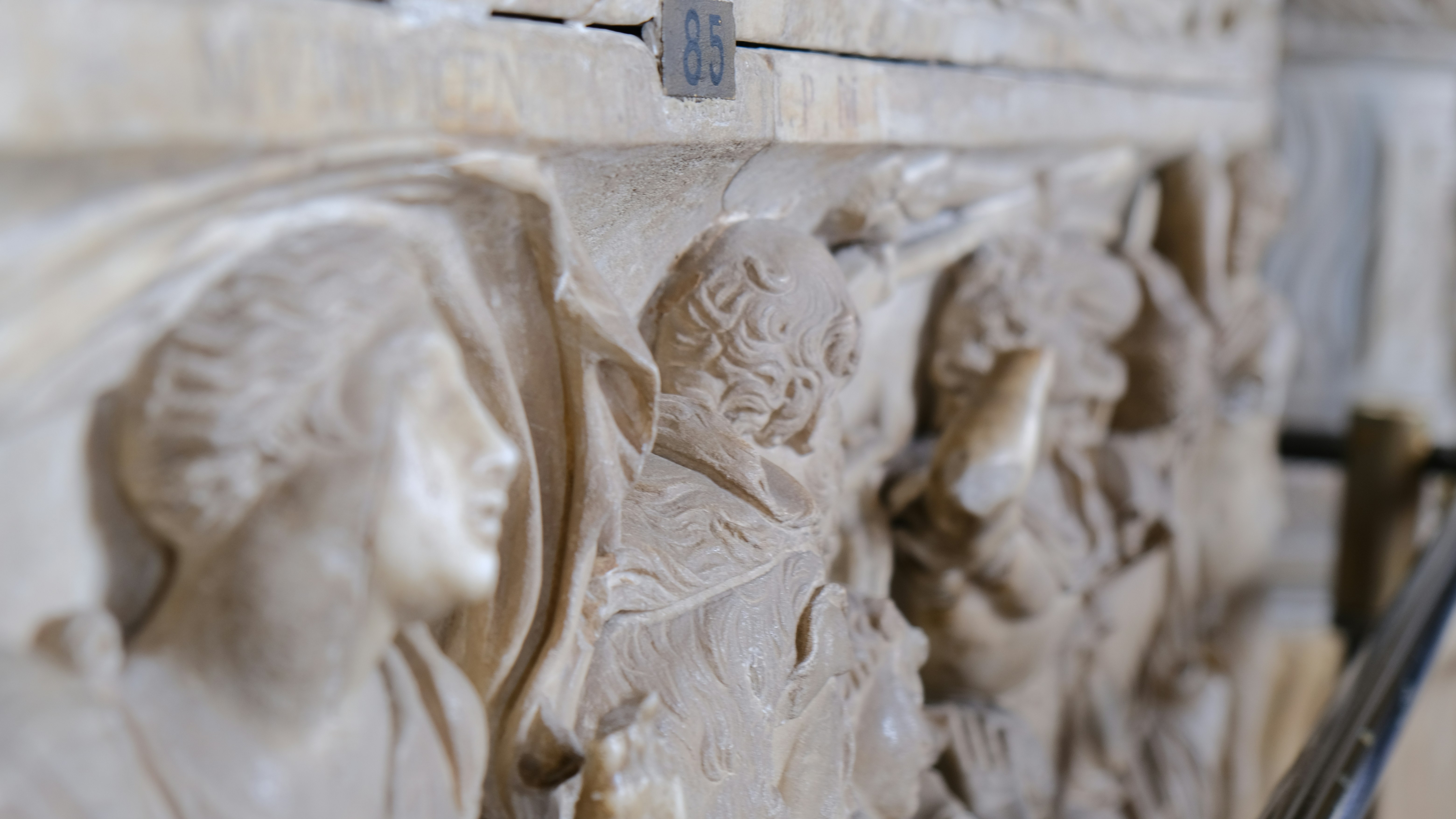
Note to reader: this piece looks best when viewed on a larger screen. Some formatting may not display correctly on mobile.
we, the chorus by Isabella Nesheiwat
Inspired by Anne Carson
(after the ruins)(after the breath)
we were the chorus.
we said what we were told to say.
entered from the left from the right from the memory
of the stage.
our feet patterned by centuries of dust.
we bowed
to the masks
that had long since
forgotten our names.
we were the murmur
that bridged the dead and the dying,
the breath between the actor’s declaration
and the silence that followed.
we remember
the limestone seats
filled with faces like shattered moons.
their hands rose to shade their eyes.
we spoke so they might not have to.
we mourned so their throats could remain clean.
we told them the truth
only when it had already happened.
somewherea cithara string snapped.
somewherea slave girl drew water
and heard our echo
in the hollow of the bucket.
somewherethe playwright smiled.
he knew
our lines would survive the gods.
we were the ones who said
alas
what ruin comes to the house of man
how terrible is wisdom when it brings no relief.
we said it again and again
until the saying became a kind of song,
the song a kind of sleep,
the sleep a forgetting.
the stage is gone now.
the masks have fallen
into the grass
like skulls turned smooth by rain.
we linger in the shape of what was once performance—
an outline of bodies,
a rhythm of absence.
we are the aftersound.
someone—
a girl, maybe—
walks among the ruins with a camera.
she pauses where the orchestra once was.
her feet trace the same worn circle
we made of ourselves.
she cannot hear us,
but when the wind moves
her hair rises
as if remembering applause.
we ache to tell her:
we were not a metaphor.
we were a body—
many bodies—
bound by breath.
when we inhaled together,
the dust of centuries lifted from the stones.
do you know
what it means to speak as one?
to feel your ribs strike another’s ribs
like kindling?
to have your grief harmonize
with a stranger’s mouth?
we did not begin as voices.
we began as hunger—
for shape,
for witness,
for a way to keep the dead company.
sometimes one of us broke away.
a single voiceswellingwith too much salt,
too much human ache.
she stepped forward.
her shadow lengthened across the orchestra floor.
(the audience leaned in, afraid of her aloneness.)
she spoke a name
we had been told not to speak.
and the playwright’s hand trembled.
he wrote her silence instead.
that is how solo began—
one disobedient voice
cut from the chord.
we did not resent her.
we envied her breath.
we envied the danger of being one.
now the ruins sing differently.
the cicadas keep time.
the wind rehearses our old refrains,
but nobody enters on cue.
we lie beneath the weeds and marble fragments.
when tourists step where our sandals scuffed,
the dust rises
in iambic pentameter.
every pebble knows our rhythm.
even the stones remember
our choreography of regret.
we were never the heroes.
we were the hinge on which they turned.
when agamemnon bathed in his red reward
we were the breath in the air before the scream.
when cassandra saw the future
we were the air that failed to warn her.
when troy burned
our voices crackled in the smoke.
we said what needed saying,
too late.
we said it beautifully,
too late.
we thought beauty
could be a kind of absolution.
we were wrong.
for centuries,
men used our mouths to speak their pity.
they filled our throats with syllables of mourning
and called it wisdom.
they said we stood for the people—
for the polis—
for the conscience of the play.
but we were their chorus, not ours.
we said what they believed grief should sound like.
we harmonized obedience.
listen—
there was a time before the script.
before the cue.
before the orchestra’s dust hardened into rule.
we remember the raw hum
of the first gatherings—
the open field where lament and laughter were the same.
a goat’s skin drum.
a circle of bodies chanting in the heat.
no stage.
no separation.
onlypulseandpulseandpulse.
then came the scaffolds.
the masks.
the director’s hand.
then came the playwright
with his geometry of sorrow.
he drew lines between
gods and mortals,
men and women,
hero and chorus.
he called it order.
we called it silence.
even nowcenturies on we speak through cracks.
through static,
through microphones that catch the hiss of our absence.
you may hear us
when the radio falters,
when the singer takes a breath too long.
we are there,
filling the space between melody and error.
we have learned
to live in the interference.
sometimesin certain theaters—
usually the outdoor ones,
where the wind is older than the script—
we return.
no one sees us.
but when an actor forgets her line
and the audience holds its breath,
we rise like dust.
we speak the forgotten word.
it tastes like stone.
we are still waiting for a play
without heroes.
a play where the chorus does not stand to the side,
but moves through the center.
a play where our voice is not commentary
but creation.
a play where “we” is not apology.
until thenwe rehearse silence.
we breathe together in the dark.
we count time
by the echo of footsteps on marble.
there is a legend among us:
that one day the ruins will open their mouths.
every column will exhale.
every mask will crumble to dustand sing.
the air will fill with all our lost refrains—
“alas,”
“what ruin,”
“how terrible,”
until the words dissolve
into the wind’s own vowels.
maybe that is the real chorus—
not us,
but the air
learning how to carry sorrow.
we were the chorus.
we watched the world end beautifully, again and again.
we learned that repetition is another name for devotion.
we learned that devotion can become despair.
we learned that despair has perfect pitch.
once, someone asked who we were mourning.
we said: everyone.
they asked who we were warning.
we said: everyone.
they asked why we still speak.
we said:
because someone must remember how to breathe together.
the theater is empty now.
the sky lowers like a curtain.
our voices rise—
not in unison,
not in discord,
but in something older than both.
a trembling in the dust.
a rhythm in the ribs of the earth.
listen closely.
we are still speaking.
we have never stopped.