Eda of the Road by Eleanor Haustof
The wind drifted through their hair, weaving them together, binding them to one another and to the long road beneath their feet. Pádraig to the right and Darragh to the left, her sun and her moon, they walked the land.
Beneath the shrouded night, they shared a single rabbit across the flames, Pádraig’s face lit in the firelight, his jaw set like stone.
“One day we’ll sit side by side at a feast in a stronghold of our own.”
Not a wish—a promise. Eda knew that by heart.
Darragh raised his cup. “I’ll drink to that!”
The mead was weak; they sobered quickly when Pádraig said, “It’s time.”
Eda’s hand leaped to her chest, her shoulders folding forward.
Pádraig looked down on her, laid his palms on her forearms, and pressed his forehead to hers.
“We’re the warriors of the road. We’ve seen wonders, we’ve fought battles, we’ve been through the worst of this world together. What are the dark fair folk of the West to us?”
She swallowed and lifted her chin.
Darragh, already on his feet, offered them both hands. “Think of what they could grant us!”
Eda dusted off her worn tunic, her round shield slung over her shoulder and a short iron sword at her hip.
Pádraig—tall and strong—at her right.
Darragh—so achingly familiar—at her left.
All three were barely twenty, though the road had weathered them beyond their years.
As her leather shoes sank into the mud and grass, the wind lifted the red curls from her face. She walked. Until the wide darkness of the sea rushed up to meet her, so vast and sudden she almost slipped off the cliff edge.
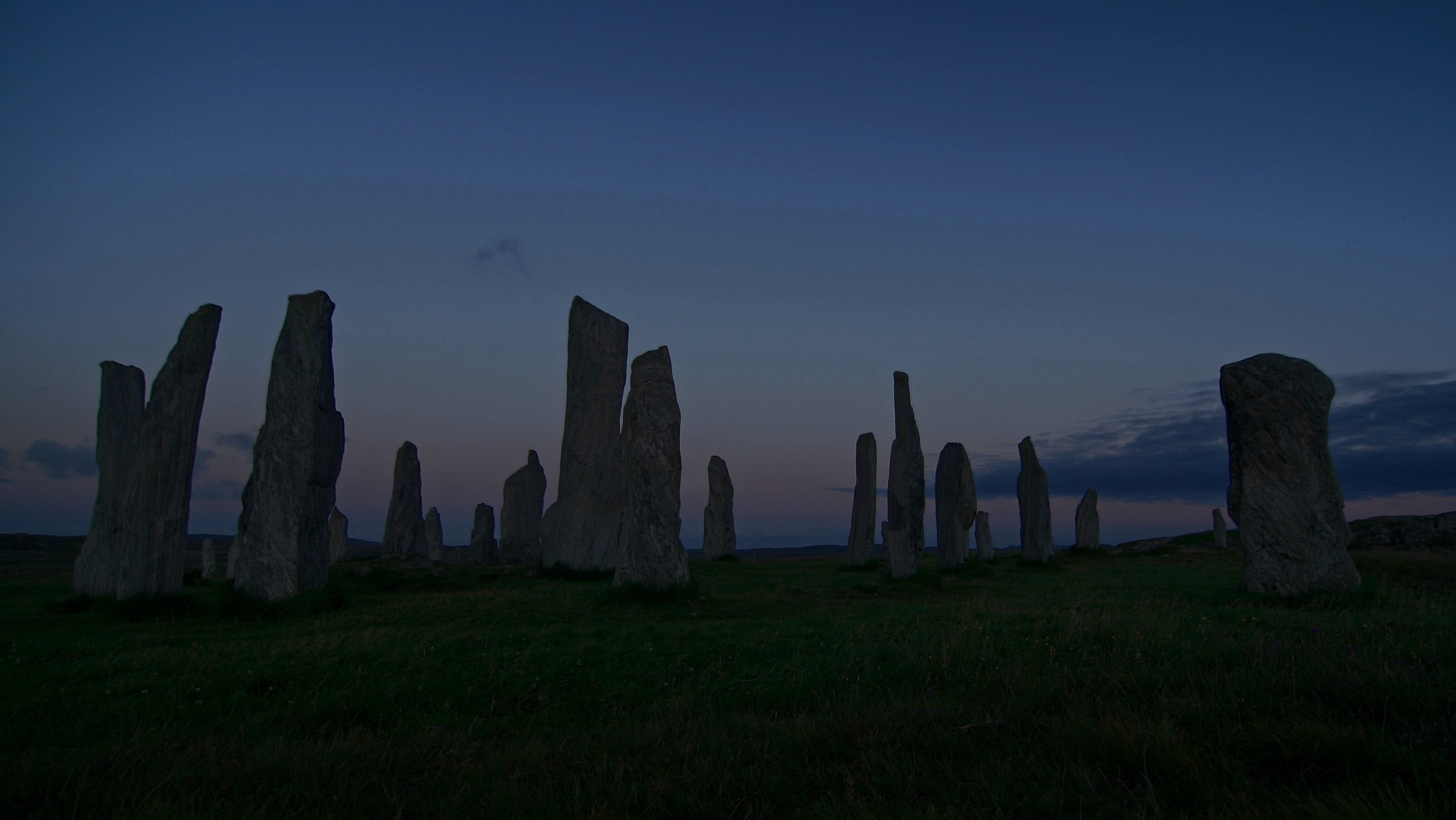
There stood three tall rocks, Ogham lines and forgotten symbols carved deep by an ancient hand. No moonlight, no fire—yet the rocks still cast shadows darker than a raven’s wings, thick as bog. Eda couldn’t shake the feeling that something was watching—an unwanted touch, too close to her skin. She gripped her friends’ hands as three figures emerged from the shadows like midnight mist.
They appeared as elderly women, wrapped in dark cloth, crowns of bird bones upon their heads. One was wide and tall, her smile stretched broad—almost kind, if it were not bordered with hunger. The Wide Fairy.
The second was small and slouched, dry as driftwood, her eyes sharp with quiet malice. The Small Fairy.
The third was hardly there at all, a wavering shape in the air—more absence than body. The Ghost Fairy.
The wind did not stir their hanging sleeves as they beckoned with dead men’s fingers, tipped with claws instead of nails.
Step within and make your wish, a whisper echoed in Eda’s head until the pain made her knees give way.
Pádraig didn’t falter.
Eda knew he was afraid too, but he never hesitated. He stepped forward; Darragh followed. Eda was pulled along, simply refusing to let their hands go.
The stone circle took them, swallowing them into an absence of sound, wind, and smell.
A tremor went through Eda’s body—as it did through her companions. Pádraig’s hand was warm; so was Darragh’s. This simple truth of them steadied her. She opened her eyes and looked around.
The space became vast and high. The clouds were gone; only the stars remained—distant and cold, pretending to see nothing. A hollow emptiness struck through her. Even the grass and mud had vanished, replaced by water so still it became a perfect mirror.
The stones rose impossibly high. Ogham cuts and other signs writhed across them in a pulsing dance, like a song she couldn’t quite catch. It enticed her—spoke to her soul, not her body. She wept.
Touch the stone, a voice whispered again, resonating inside her head like rocks collapsing from a mountain’s peak.
The unseen pressure bore down on her, squeezing her skull, her ribs, the very breath from her lungs.
The taste of blood filled her mouth.
She fell to one knee.
Her hands slipped from her companions’ fingers—they were already moving away. Her palms hit the dark water, her head bent, hair spilling to both sides like curtains threaded with copper and gold.
But all she could see was herself. Not the familiar reflection of a polished dish, but another Eda—a future pulled from the dream they had shared night after night beneath a lone tree on the open land.
It was Eda still. And it wasn’t. This Eda stood tall, shoulders set, chin high. She wore a green gown, a crown of golden leaves upon her head, as if it had always been meant for her. She sat on a throne—heavy, wrought of iron, cushioned with red cloth.
The vision hooked deep into her chest, anchoring her gaze. To never freeze again, to never starve—the phantom warmth of that throne seeped into her skin, washing away the memory of the wet earth. There she had everything.
Everything? No… that wasn’t quite right.
Something was missing, slipping away from her memory.
Them.
Eda breathed in. The false dream unraveled. The reflection tempted her—but with no Pádraig at her right, no Darragh at her left, it was useless.
The pressure broke and vanished in that instant.
She rose to her feet. The mirror-water beneath her did not ripple; it remained cold and flat, the image of the crowned Eda gone from its surface.
She turned to her right. Pádraig was twenty paces away, kneeling at the base of a stone that rose like a frozen lightning bolt. He wasn’t looking at the Ogham cuts. He was pressing his forehead against the rock, his hands gripped tight around a shadow only he could see. His face was radiant, the lines of exhaustion smoothed away by a fevered gold light.
The Small Fairy tilted her head and licked her lips, pleased with his obedience.
He looked like a god—the shine was so bright his shadow stretched across the circle, deep and black, all the way to Darragh. Beside Darragh, the Wide Fairy laughed—loud, thick, and clinging. Her laughter rolled across the stones like tar. White breath escaped Darragh’s mouth. His eyes were wide with a terror too large for words.
He does not fear him, Wise One, the voice murmured beside her ear. It’s envy.
“Pádraig!” Eda called out. “Darragh!”
Her voice was thin and fragile in the uncanny silence of the circle. She wasn’t sure it even passed her lips.
The Wide Fairy laughed louder and wilder—the bone crown rattling with her laughter. Darragh reached for the stone with both hands, collapsing under its will. His forehead pressed to it with the desperation of a last refuge.
Pádraig spoke then.
“I want it,” he said to the stone. No mead or cold clouded his voice. It was deep and terrifyingly sure. “Walls that do not fall. Gold that does not tarnish. I want it all.”
“And I,” Darragh whispered, his eyes wide and fixed. “I want to be the one who leads the way. I want the crown that matches his.”
“At what cost?” Eda begged her friends.
She felt it then—a coldness settling in her marrow that had nothing to do with the winter. She looked at the Ghost Fairy—the one who was barely a smear of mist in the air.
The Ghost Fairy drifted toward her. She had no eyes, only two hollow points of absolute emptiness.
The cost of the Midnight Trade is the one thing you all share.
Pádraig didn’t ask what it was. Neither did Darragh. Their hands moved in identical, hypnotic arcs, sealing it in the air.
“Take it,” Darragh said. “I have no money. If such wealth can be bought with the nights under roofless skies or hunger or the endless road—you keep it all.”
Eda’s breath hitched.
“I make no trade,” Eda said. Her voice didn’t waver. “I’ll keep the road and the dirt.”
The Wide Fairy laughed again. The Small echoed.
The Ghost simply said, So it is written.
Small lights rose from Pádraig’s and Darragh’s chests, floating within the circle of stones, pulsing in the same rhythm as the Ogham cuts. Eda stretched out her hands, desperate to stop them. The lights leaned into her palms, as if reluctant to leave.
She clung to the rhythm as if it were a lifeline, until a gust tore across her face. The sea-mist was back, tasting of salt and loss.
She knew it then—the fairies were all gone.
The glowing lights had vanished with them.
The wind carried the last words of the Ghost Fairy:
In seven years, we’ll return for another trade with mortals. You will come along too, Eda of the Song. You alone will remember the hunger while they feast. Then we will trade that heaviness of your heart.
Pádraig and Darragh were already standing, their gazes fixed on the horizon.
“I shall go to the East,” Pádraig said, pointing toward the sunrise.
Eda took Pádraig’s hand as she always did. His skin was chill, but his grip was gentle.
Darragh’s eyes dropped to their joined fingers, his lips twitched.
Eda reached for him, eyes pleading.
He simply turned.
“I take the road to the South.”
Darragh walked then. Away.
Pádraig drew her along. Her eyes clung to Darragh as he shrank smaller and smaller on the horizon.
***
The stronghold stood tall and unmoving—a dream alive. Its grey walls rose hard from the earth, banners stirring high above, heavy with color and gold thread.
An iron-bound wooden gate stood open before them, framed by walls no storm could break. Within, a wide yard spread—orderly, alive. Horses stamped in their stalls, their coats brushed to a shine. Servants crossed the yard with lowered heads, carrying baskets, water, tools of steel.
Exhausted and shaken, Pádraig and Eda stopped by the gate.
One by one, the people of the stronghold turned, a murmur passing through them like wind through tall grass.
They bowed.
Not in curiosity. Not in doubt.
In knowing.
“My lord,” one said.
“My lady,” said another.
Pádraig lifted Eda as though she weighed no more than a feather and carried her through the gate, into the inner rooms, as if it had always been so.
The bed was soft, the linen sweet with herbs.
When Pádraig kissed her for the first time, she froze for a moment. But he was her sun, and she had almost lost him. So she clung to him and kissed him back.
Seven years passed. The Midnight Trade faded from them, as though it had never happened at all.
Only a song stayed.
Some days it brought Eda to tears. On quiet nights, it wrapped her in the warmth of the laughter they had once shared. The longing for a time when they were everything to each other—and the knowledge that it was gone forever—would not let her rest.
“Remember the time the giant chased us into the peat bogs?” she asked Pádraig one night as he sat over a map of the borderlands.
Pádraig looked up. His eyes were clear, bright, and utterly blank.
“The bogs? We have no giants in our province, Eda.”
Her hand drifted over his shoulder—no velvet or fine cloth could hide the bearing of a warrior of the road.
“Do you recall that old, twisted tree, torn by the wind, where the grass bent and stretched like sea waves? The fire and us sitting close, one blanket over our shoulders?”
His eyes were full of love as he tucked a stray curl behind her ear. She wasn’t even sure if he was listening. But the name slipped from her lips before she could swallow it back.
“Do you remember Darragh?”
His eyes turned bitter.
Darragh had claimed a valley two days’ ride south, raised his towers higher than Pádraig’s—and now the crows brought word that he was gathering an army.
“I meant to say—if anyone can settle a war over mead, that is us.”
A pause stretched too long. Eda could almost hear the laugh of the Wide Fairy.
“He is not the man you remember. He no longer stands at my side, nor keeps you safe,” Pádraig said quietly.
Then he covered her hand with his and nodded.
“So be it. Let’s feast with Darragh.”
Eda leaned into him, breathing out against his shoulder—then he added, “We can always start the war tomorrow.”
***
The harp played softly from the corner of the Great Hall. A group of finely dressed musicians sang a cheerful song—their faces welcoming, eager to please.
Five long tables stretched across the hall, benches set close along both sides. Clay jugs of sweet wine stood ready, and washing bowls waited for the guests to arrive.
Still, Darragh had not come.
Not when they poured the soup and set down the bread.
Not when they laid out platters of pork with carrots and leeks.
Not when they brought the roasted chicken, the smell of herbs and onions rising with it.
Pádraig toyed with his knife for a while—the food untouched on his plate. Then he gripped it and drove it into the table so deep that two servants couldn’t pull it free.
“Who does he think he is? Son of a farmer and a drunk,” Pádraig said, his voice low, but carrying.
Eda took his hand in hers—their matching rings met with a soft clang—and lifted it to her lips, his fist unclenching with every kiss.
“He’ll be here,” she said. “You know Darragh. He must be worrying himself sick—what you think of him, whether he’s finally worthy to stand beside you.”
“He looks anything but worried,” Pádraig said. His eyes were fixed on the door.
Eda turned.
Darragh stood at the threshold of the Great Hall.
He had dressed as a king. A cloak of fine wool fell from his shoulders, heavy with gold thread, a clasp at his throat shaped like a rising star. His hair, once wind-tangled, was pulled back and bound.
And yet—
He stood just a breath too still.
As if waiting to be seen.
As if measuring the room before stepping into it.
Beside him stood his wife, beautiful in the way still water is—clear, untouched, and giving nothing back. A pale blue gown clung to her frame, its borders worked with silver thread that caught the candlelight. Her hands were folded before her, fingers unmoving.
Her eyes passed over the hall without resting on anything at all.
Darragh’s gaze found Pádraig first.
Then Eda.
She couldn’t stop staring, her heart hammering.
She missed him. She missed them even more.
So they sat—Pádraig to the right, Darragh to the left—her sun and her moon.
In nature, things fell into their proper places. Yet at this heavy table, nothing felt right.
Darragh’s wife sat beside him, a masterpiece of silence. She ate her chicken as if it were a chore, never once looking at her husband.
The last dish was served—the tart of sour apples that grew only near their village. Eda had gone to great lengths to find them, to have it made as it had been in their childhood.
The conversation flowing over the tart was no longer an exchange of words, but of stones.
“The Southern towers are visible from my room now, Darragh,” Pádraig said, his voice like the grinding of millstones. “They cast a long shadow over the valley. My people find it… unsettling.”
Darragh leaned back, his gold-threaded cloak catching the candlelight. “Shadows are the price of height, Pádraig. I find that if one builds high enough, one no longer cares what everyone else thinks.”
Eda no longer recognized the men to her left and right. But the song of the road beat against her ribs.
She stood up. The chair scraped against the stone—a raw, ugly sound that cut through the conversation. Pádraig glanced at her, confused. Darragh didn’t look up at all, but his fingers tightened around his wine cup until it bent.
She didn’t say a word.
Instead, she crossed the hall and took the small harp from the lead player’s hands. It felt frail in her grip, too slight for the song rising in her chest.
“Enough of the strongholds,” Eda said, her voice echoing in the rafters. “Enough of the walls.”
She walked back to the high table, the small harp held close to her chest.
She struck a chord. It wasn’t courtly. It was the rhythm—the jagged, pulsing beat of the lights she had caught seven years ago. It sounded like footsteps on gravel, like a heartbeat in the cold.
The words came on their own. A musician with a hand-drum caught the rhythm after her.
“Nine years it took to grow together. A little less to grow apart.
The friendship meant to last forever.
Yet shattered like winter ice…”
The words poured out of her. One chord after another. Some heroic. Some not at all.
When she sang of cider in the northern hills—of them sneaking out at night to steal it, of Darragh tripping over a basket, of a pig screaming the valley awake—
Pádraig’s jaw loosened. A smile—the real one, the one that lifted Eda’s chest—danced on his lips.
And Darragh’s wife blinked at Eda as if she were some strange thing.
When she sang of the moon and stars, of the fire burning high, she glanced at Darragh—silent tears shone on his cheeks. He gave her the smile she had missed so desperately—unguarded, open, and undeniably his.
The ghost of what they had been flared up in the hall like a dying fire. The air grew suddenly warm, and for just a moment, the silk and the gold felt like nothing but heavy, suffocating costumes.
Darragh held her gaze a moment longer—she thought he would take her hand again, and they would live as they had always meant to. She reached out—
He stood so abruptly he knocked his wine over. The red liquid bled across the pale cloth like a fresh kill.
He did not look at his wife. He did not look at Pádraig. He only looked at Eda one last time—desperate, as if it could not be stopped.
Then he fled the hall, his fine cloak snapping behind him like a broken wing.
Pádraig went after him.
So did Eda.
Pádraig kicked the heavy oak doors open into the storm. Outside, all they found were fading hoofbeats and rain striking hard, driving every living thing to shelter.
In an instant, Pádraig was on horseback.
So was Eda—the velvet of her dress soaking, the crown and the small harp shoved into a saddlebag.
“This is the road to the stone circle!” Pádraig shouted over the wind. “He is not just gathering an army—he is seeking a greater weapon, too!”
“No, Pádraig! I don’t believe that,” Eda cried, gripping the wet leather of the reins. “He is breaking…”
She didn’t know why she said it, or what she had seen in his eyes. But she was sure of one thing—he needed them now more than ever.
They rode.
The two-day journey of their youth was devoured in hours by the swift horses of kings.
As the edge of the cliff rushed toward them, Eda felt it before she saw it—a gaze pressing against her skin like an unwanted touch. It spread through her like a fever. Her belly twisted with the familiar cruelty of this place.
Darragh’s horse stood shivering and lathered near the three tall rocks. Darragh himself hesitated at the edge of the circle, as if frozen there. The Wide Fairy beckoned to him with a finger of a dead man. His fine cloak lay torn in the mud like a discarded skin.
“You shouldn’t have come.” His voice was barely audible beneath the crushing storm.
Pádraig wrenched his horse to a halt and leapt from the saddle. He drew his sword, the steel flashing in the grey light. “Step away from the circle!”
Darragh lifted his chin, defiant, and stepped inside.
The Wide Fairy laughed louder—that thick, clinging sound that Eda felt in her teeth.
Eda slid down from her horse, her legs giving way the moment her boots hit the earth. Years in the stronghold had softened her; she had forgotten the treacherous mud of the road. As she lunged forward, she slipped and fell hard to her knees.
Pádraig didn’t notice her. His gaze was fixed on Darragh, now falling to his knees before the Wide Fairy and the stone. His eyes closed, his lips whispering words they couldn’t hear.
Then Pádraig looked at his own hands. They were trembling.
He stepped forward. Before Eda could rise, he was already inside.
“No!” Eda cried, half-crawling, half-stepping into the circle. Her red curls whipped around her face.
“Pádraig, Darragh!” Her voice echoed through the emptiness of the other space—all the way up and all the way down, there was only a scatter of stars and the black mirror of water between. “You heard the song. This is the truth of us. The truth we should live by.”
Pádraig turned to her. His eyes—distant, careful—those of a man saying goodbye.
“My dear Eda,” he said quietly. “The road was heavy, but full of dreams. My dream came true, and I need to protect it. I am a king, and a king cannot be a brother.”
The Small Fairy moved to him. Her hand forced his forehead to the surface of the stone. “Make your wish.”
“Take my memory of the road. The ache I cannot carry. I want to be the king of the land, not the king of the ghosts.”
Eda gasped.
Darragh smiled at her sadly. “Even in this, he is first.” He nodded to himself. “Not for long. Without the road between us, we’ll stand the same at last.”
Eda pressed her hands over her heart. “Why did you always want to outrun him? To impress him?”
Darragh closed his eyes for a fraction of a second. A tremor passed through his face as he whispered, “Not him.”
Eda took a step back.
She forgot to breathe.
The Wide Fairy pressed his forehead to the stone beside Pádraig.
The Ghost Fairy—that smear of mist—drifted toward Eda.
The debt is due, the Ghost murmured, her hollow eyes drinking Eda’s agony. They offer up their yesterdays to settle the account. They want to be light, Eda of the Song. You should too. No mortal can carry this pain.
Eda wiped her cheeks and gave one last look to the men who meant the world to her—then turned to the Ghost Fairy. One corner of her mouth lifted as she said, “I keep the road and the dirt.”
The three fairies moved in unison. Their clawed fingers traced the air.
So it is written, they whispered.
A great silence fell. It wasn’t the absence of sound; it was the absence of the past.
The pain vanished from Darragh’s eyes. The longing vanished from Pádraig’s. Their features smoothed, becoming as perfect and indifferent as the Ogham lines on the stones.
They stood.
Darragh looked at Pádraig. His head inclined with a polite, frigid grace.
“A fine night for a ride, my lord,” Darragh said.
“Indeed,” Pádraig replied, his voice as smooth as polished glass. “I believe my border guards are expecting me. Safe travels to your valley.”
They didn’t look at Eda. To them, she was simply a woman standing on a cliff—a part of the landscape they no longer had a reason to map.
The wind blew into her face, lifting her hair, setting it free.
They went to their horses.
Eda took the road to the North.
***
The legends speak of a Bard of the Road, who walks the land with a small harp at her back—dressed as a noble lady, yet bearing a sword and shield.
The fairies had sought to swallow the yesterdays of the three and the road beneath them.
But a story told to a thousand ears is a debt that can never be claimed.
And so the Bard walks still, her song a river that cannot be dammed,
carrying the memory of friendship, laughter, sorrow, hunger, and fire—
into legend,
into eternity.