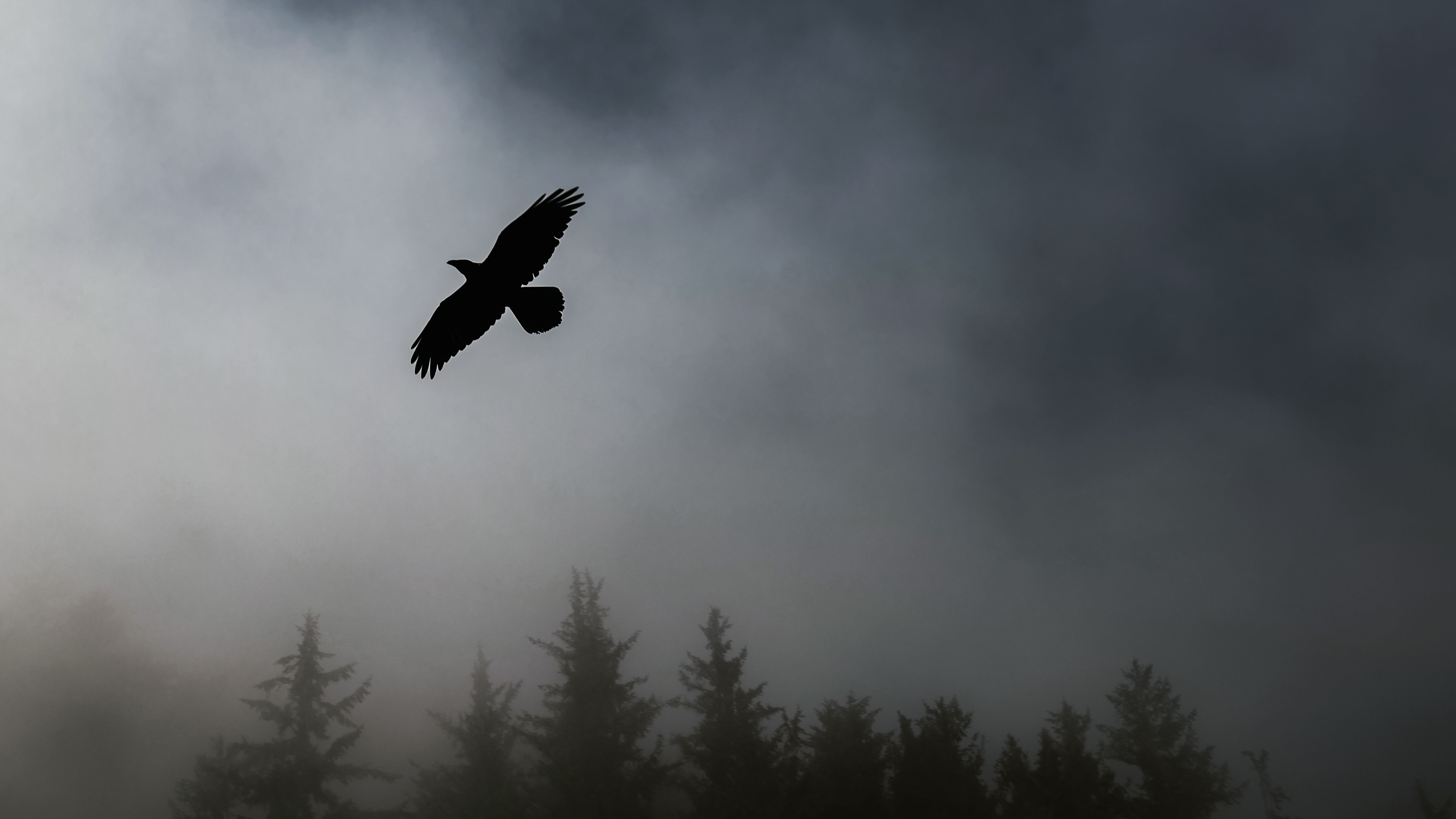
Hidden Valkyrie by Murray Eiland
The Raven’s Mark
The barn groaned like a dying beast, flames leaping from its ribbed rafters, projecting blood-orange light across the night sky. Smoke spiraled skyward, choking out the view of the stars. Beneath the collapsing beams and shrieking heat, a voice cut through the calamity. It was barely audible and pressed with age, dry and ragged like brittle parchment.
“Why did you hide, Runolf?”
He flinched. Her voice did not match the intensity of the fire. It was older than the blaze, older even than the barn—something from the dark soil, from the old ways.
In the corner where shadows gathered, Runolf Hrafnsson clutched his knees to his chest. Sweat slicked his brow, but his skin felt frozen and numb. The forge had taught him heat. But not this. Not the smell of burning flesh and fire-engulfed homes.
He did not answer at once. The embers answered for him in crackles and howls.
“I am not...” His voice faltered, caught between breath and shame. “...a warrior.”
The old woman moved closer. Her steps were small—bones grinding beneath withered flesh. Her eyes, clouded by time, found him nonetheless. A hand, veined and twisted like a storm-bent branch, found his arm and held.
“You are a shield,” she murmured. “And a shield breaks so others do not.”
Her touch burned hotter than the fire, yet it somehow eased his troubled mind—if just for the minute. He could hear voices from long ago, when children taunted him. They jeered at him for not having parents. He largely raised himself after they disappeared, and he couldn't care less. The insults that stung were about him being afraid. As a child, he insisted he was cautious. He thought things out. But, he thought, those cruel children had a point. And maybe if he were so good at thinking things out, he would not be trapped in a burning barn right now. He made a silent vow to Odin that he would now take responsibility for being in the barn. He steered this fate. He also vowed that, if necessary, he would give his life for the old woman who was also in the barn.
Strangely, the woman seemed unafraid. She spoke as if conjuring from memory, or perhaps from something older than thought—a tale of Eir, Valkyrie of the Raven, whose banner bore not a blade but a leaf, not death but healing. “Not all the chosen wear war upon their brows. Some are chosen for what they endure.”
Runolf was not listening to her at all. His mind was racing. Above them, the rafters gave way with a crunch. He knew what came next, and he knew he had to act fast.
Runolf moved before the fear could take root within him once again. He tore off his cloak, rough wool catching sparks as he wrapped it around her frail shoulders. The air was thick as pitch, smoke clinging to his throat like oil. He opened his mouth, and the cry that rose was hoarse and broken. Runolf pulled her close and charged into the fire.
The blazing world around them narrowed to agony—screaming temperatures, splintering wood, greedy flames flaying Runolf’s skin. The woman, despite her labored breathing, had only minimal scratches. He could no longer feel his legs; he could only sense motion. The barn behind them collapsed in a funeral of cinders as he staggered out beneath the deep indigo sky.
The village was ablaze with war cries and steel. Yet for a heartbeat, all fell silent.
They had seen him.
Runolf, the apprentice, blackened and broken, bore the old woman in his arms as if she weighed nothing more than a sack of feathers. They watched as he laid her down beyond the fire’s reach, his flesh smoldering, his breath shallow.
Then the silence broke—with the whisper of wings.
From the smoke came the holy light. The air around them shimmered and tickled the skin. The plumes of mist cascaded like a waterfall, splitting in the middle. Through the center stepped a woman, followed by another woman. Tall and still, all clad in pale armor forged from moonlight. Each step they took was in unison and soundless. Their cloaks billowed behind them like a breath of winter mist, and from their helms spilled hair the color of golden starlight. Eyes like storm-washed steel swept the battlefield, yet their beauty appeared calm and untouched by the carnage.
Valkyries.
They passed over the battlefield like wind over wheat, gathering souls with their eyes alone.
One broke from the rest.
She stood before Runolf—he did not stand tall, his fear and fatigue wouldn’t let him. The Valkyrie towered over him. Her armor bore not spear, nor shield, but a raven, etched in shadowed silver.
A cool hand found his shoulder.
‘Your time has come.’
He looked up at her.
The pain was gone.
The fire… gone.
His hands were no longer blackened. Runolf stood beside his body, and the world blurred at the edges.
“I have no place in Valhalla,” he whispered. “I am no hero.”
The raven-bearing Valkyrie stared into his eyes. ‘And yet, you crossed fire to save what most would leave. You bore your fear.’
She raised her hand, pressing two fingers to his brow. Coolness flooded him like snowmelt. His wounds knit themselves with light.
‘You are not finished. Your story still has chapters to write. Death shall not meet you today.’
His breath hitched. “Why?”
‘The raven has chosen you. The world needs more heroes than the halls need their souls. Prove yourself worthy, and be ready next time you see me.’
The Valkyrie vanished with the wind. Runolf stood again in the ruin.
The village had survived, barely. The raiders had retreated.
In the days that followed, Runolf rebuilt what he could. His hands still bore scars, though his body was whole. The old woman lived, though she faded fast, her voice dwindling to whispers and mutterings.
Gudrun, the old woman, beckoned him close one evening, eyes flickering with the last embers of life.
“Seek the raven,” she said. “Follow where it leads. To your destiny.”
Runolf, apprentice no more, exited her home and stood beneath the ash-gray sky. As he stared up at the early night stars forming overhead, he noticed a raven wheeling above the blackened trees.
“My destiny?”
The Raven’s Watch
Days turned slow as honey, though none were sweet. Smoke no longer curled from blackened beams or tainted the air, and the blood in the soil had long since vanished. Yet the new addition of grave markers in the local cemetery carried the truth.
Runolf rose early. He tended to Gudrun before addressing his own needs, bringing broth and herbs, cooling her brow when the fever came, warming her limbs when the night crept in cold. She grew stronger—first in voice, then in body. Her laugh returned, dry as leaves in autumn, but it returned nonetheless.
Still, he could not rest.
A fire of another kind stirred within him—not one of destruction, but of becoming.
He remembered Eir’s voice. ‘Prove yourself worthy.’
So, he worked the land by day, splitting roots and stones with a restlessness he could not name. When he slept, it was fitful, dreams tangled with wings and whispers—sometimes nightmares. But they didn’t frighten Runolf. He felt more like they were preparing him for what was yet to come. He welcomed the challenge.
It was on such a day, with the sun climbing pale through the fog, that he saw another raven.
It was a young corvus, slender of frame but holding itself with an uncanny dignity. Perched high upon the crooked limb of an ash tree, it remained still and watchful.
Runolf halted mid-step. The spade slipped from his calloused hands and sank into the furrowed soil with a barely audible crunch. His breath caught in his chest as he gazed upward, heart thudding against his ribs. Slowly, almost reverently, he approached the tree—his steps careful and measured, as though he were drawing near not a bird, but a shrine.
“You’ve come,” he whispered.
The raven tilted its head, one bright eye fixed on him.
Runolf tore a hunk of bread from his satchel and placed it on a flat stone, then took a step back.
The bird studied him a moment longer—then hopped down, took the bread in its beak, and departed in a flutter of shadows.
Runolf did this the next day. Then the next. Then the next...
By the seventh day, the raven no longer fled. By the tenth, it remained nearby even as Runolf worked. By the twelfth, he took the bread directly from Runolf’s hand.
He named it Huginn, as in the tales—Thought, the watcher from Odin’s shoulder. The villagers whispered of fate, of the gods’ mark.
Huginn became his shadow.
At dawn, perched on the roofbeam.
At dusk, roosting in the ash outside.
And always, those eyes—sharp as spearheads, yet ancient as starlight.
Gudrun saw, and she approved.
“There is more to that bird than feathers,” she told him.
Runolf smiled at that. “Then it may have made a poor choice.”
Her laugh was short. But above all, it held a tinge of youthfulness it hadn’t held in decades.
One morning, Gudrun told Runolf that he “has the makings of a fine archer.”
“That so?”
“It is,” she replied, handing him her walking stave. “You have steady hands. You also don’t like dealing with your fears head-on, but you do. Archery allows you to do that from a safe distance.”
She wasn’t wrong. However, Runolf had never touched a bow before. The first time he drew it, the string snapped. The second, the arrow landed in the mud a dozen paces short.
By the fifth arrow, Huginn cawed once—clearly amused.
“You could help, you know,” Runolf muttered.
The raven only blinked.
But he trained each day until his fingers blistered and his arms were sore. He carved targets into logs and painted crude circles on the bark. Soon, his arrows began to whisper through the air more true than false. Each miss stung less—and the misses themselves started to happen even less.
More importantly, each success fed Runolf’s experience and character, rebuilding himself in ways he didn’t know he could.
He began to dream again.
The Return of Hrafn
Morning came not with fanfare but with a hushed breath beneath a sky pale with frost. The wind was thin and sharp, like a blade drawn across old cloth.
Smoke curled lazily from the village hearths, mingling with low mist that clung to the ground like a ghost, reluctant to lift. The crows were silent. But the raven cried out—one sharp caw that cracked like lightning.
Runolf turned at once, catching Huginn launching into the air with his wings, slicing through the veil of fog. His eyes followed the arc of flight, and there—through the silver mist—moved a figure.
At first, it was only the impression of movement: a shadow against shadow, limping yet unyielding. Step by step, the mist parted, and the man took shape. His beard was wild, streaked with silver and tangled like the roots of the old ash trees. His cloak was torn, weather-beaten, and pinned with a brooch that bore the mark of a long-forgotten warband. But it was his eyes that arrested all who looked—ice-blue and burning like the winter stars.
Hrafn.
Gasps rippled through the villagers like wind across a field of tall grass. They gathered without speaking, eyes wide, mouths ajar. Many had whispered his name over the years, but only in the past tense. Hrafn the Lost, now found—standing among them, no less. Alive and unbroken after many long years.
He looked at Runolf and lingered on the raven that circled once above before settling on the boy’s shoulder. A grin crept across the old archer’s weathered face.
“So,” he said gravelly, “you’ve found your weapon.”
Runolf stepped forward with his bow in hand. “Aye. I seek your guidance. I would learn from you. I wish to become an archer—not just skilled, but worthy.”
Hrafn’s grin turned unreadable. “And why,” he asked, a spark of mirth in his eye, “should I waste my days training a boy the wind could knock over?”
The villagers chattered nervously, but Runolf did not flinch.
“Because I was spared. By Eir herself. She gave me back to this world. I will not waste the gift hiding from its dangers. I’ve known fear. I will not kneel to it again.”
Silence fell upon the village.
Hrafn stepped forward, the limp heavy but steady, and clapped a weathered hand on Runolf’s shoulder.
“Eir, eh?” he smiled again. “She always did have a soft spot for the broken… and the brave.”
“I am both of those things.”
“Aye,” Hrfan nodded to Huginn. “The raven’s chosen you. That counts for more than you know.”
Gudrun emerged from her home, leaning on her staff but walking straighter than she had in days. She looked between the two men—one young and untested, the other worn by time—and her eyes shone with hope.
“Hrafn,” she said, “teach him. Teach him, and we rebuild more than roofs and fences. We rebuild our strength. The next time the wolves come, we will not meet them with fear.”
The old archer lingered on her, softening for a breath. Then he turned once more to Runolf.
“As you request, Shieldmaiden.”
Then his tone turned grave.
“Know this, lad. The bow is no easy path. It demands not only aim but calm. When the shield wall breaks and steel comes roaring down upon you, there is no time for doubt. Your nerve is the final arrow in your quiver—and it must never miss.”
Huginn cawed out in agreement.
Runolf said nothing, but met Hrafn’s stare with firm eyes of his own. Huginn cawed once from his shoulder, and thus began the next forging of Runolf—not with fire and hammer, like his past would suggest, but with string, wood, wind, and will.
The Bow and the Bird
Under Hrafn’s ruthless tutelage, the cadence of Runolf’s life shifted like a pond beneath a storm. The mornings began before the dew had gathered, before even the village dogs stirred. By the time the sun lifted its golden eye over the hills, Runolf had already loosed dozens of arrows, each one judged with a grunt, a glare, or—more cutting than either—a silence from the old archer.
The training was grueling, inventive, and relentless.
He made Runolf fire blindfolded, guided only by sound. He taught him to strike moving targets—clay pots suspended from branches, swinging like pendulums. He sent him into the forest barefoot and unarmed, with nothing but his bow, forcing him to stalk prey silently and return with proof of his patience. He made him stand waist-deep in a freezing stream, bow in hand, and shoot until his fingers were numb and shaking.
“If you can shoot when the world tries to break you,” Hrafn barked, “then you’ll shoot when men do.”
Runolf’s fingers blistered, then bled, then hardened into calluses. His shoulders ached so fiercely by the end of the week that sleep came in a collapse. But not once did he complain. Pain was his tithe. The memory of fire still licked at the edge of his dreams, and Eir’s voice lived within the marrow of his bones.
Always, Huginn watched.
The raven perched on low branches or rocky outcrops, studying Runolf’s trails with its obsidian eyes. In the beginning, each time Runolf’s arrow sailed wide or thudded limply into the dirt, the bird would let out a sharp, unmistakably mirthful caw.
At first, it stung.
Hrafn chuckled. “Your bird mocks you.”
But Runolf listened closer. There was a pattern in Huginn’s cries—it was no random heckling. A call came after every mistake, and silence when Runolf nearly struck true. Over time, the apprentice archer understood what was happening: the caws were not laughter, but Huginn’s way of offering correction.
Runolf heeded them, and things began to change.
The strange bond between them deepened. And as Runolf’s hands grew more certain and his mind more still, the cawing became rarer. Eventually, it stopped altogether, replaced by a stoic presence.
Weeks slipped into months, and with them, the boy who had once hidden in the shadow of flame disappeared. The village watched in quiet awe as Runolf moved through the fields and forests with the grace of a predator. He had grown lean—his muscles no longer broad like the blacksmith’s, but honed like wire drawn tight.
His arrows flew straight and true—so much so that villagers whispered that the spirit of Ullr must guide his hand. Some said he would soon rival Hrafn himself. Others said he had already surpassed him.
But still, Runolf said nothing. There was no pride in his silence, only purpose.
Hrafn approved of the soldier he had helped forge.
“He no longer shoots like a boy,” Hrfan told Gudrun one evening as the sun bled red behind the pines. “He aims as a man who knows death waits behind every breath. And the bird takes to him like the Allfather.”
It was true, but Huginn belonged to none.
He was not a pet, nor a tamed thing. He answered no command, wore no tether, and bowed to no hand. His soul, like the wind, belonged to the Allfather, and all the world knew it. But still, the black bird stayed, perched at Runolf’s side out of respect. Or perhaps it was kinship. And Runolf, though never once giving voice to it, understood his role was the same.
The Truth of Ash
The snow had not yet come, but the wind carried its breath. The village was quiet after dusk, heavy with the scent of hearth smoke and the cold, damp earth. Runolf sat sharpening his arrowheads by the fire, Huginn perched silently in the rafters above, a shadow within a shadow. The bird had not spoken in days—not in caws nor riddles nor signs—and the silence unsettled him.
Then came voices in the dark.
Not shouting. Not raised. Just voices—they were familiar and threaded with an energy that stirred the hairs on his neck.
Outside, under the starlight, stood Gudrun and Hrafn. When Runolf approached them, they turned to face him in unison.
“We are not,” Gudrun said, “exactly what you believe us to be.”
Runolf’s hand drifted to the bow at his side out of habit.
“You’re not mortal,” he said, the words spilling out before his mind caught up. “You—” he looked to Hrafn, “you’re Odin.”
At this, Hrafn laughed—a deep, bellyful sound that echoed off the pines.
“Odin? No, lad. But close enough to smell his pipe smoke. There are Asgardians who walk Midgard still, not gods, but not men either. We serve, in ways permitted by the old treaties. After the war with the Jotnar, the Allfather made peace with the giants. The law is clear. No direct interference in the affairs of men.”
He looked toward Huginn, who now fluttered down beside Runolf.
“The raven’s not Odin’s,” Hrafn said. “But close enough. A messenger of sorts, or perhaps more of a guide. He came when the fire rose because something ancient stirred beneath that barn. Not just you, boy. Her.”
Gudrun stepped forward. “I was once a Valkyrie. Not one of glory—but of shame. I faltered in battle, feared when I should have flown. The Allfather stripped my wings and cast me down to earth. I’ve lived many lives and wielded many blades. But this last one... it aged me. I was tired. I wanted to burn with the barn.”
She looked upon Runolf. “And then you carried me out.”
He swallowed hard.
“You were never meant to save me, Runolf. But you did. And now the others remember me. They whisper that perhaps I am not lost after all.”
The air shimmered around her as she spoke. Hrafn placed a hand on her shoulder.
“It’s true, lad. She’s earned her blade again. But she must fight for it.”
Runolf stared at them both. The stories, the ravens, the second chances—it all felt like something from a skald’s fever dream.
“Is this all... allowed?” Runolf asked. “It sounds like cheating.”
“Lad, until you’ve known the tricky trickster himself, you’ve not known real cheating.”
Hrafn raised his hand, and a ripple of silver light spread outward like the surface of disturbed water. Gudrun was engulfed in it. Her old, bent frame dissolved into light—her bones unwound and reknit, her muscles tightened, her hair spilled down like gold. In seconds, she stood anew: tall, radiant, fierce-eyed, clothed in the echoes of her former self.
A shieldmaiden reborn.
“Now,” she declared with newfound vigor, “let’s prepare for what comes next.”
Together, they returned to the armory of the dead—the battlefield ruins from the first raid. Beneath the earth and broken timbers, they excavated weapons not forged by human hands: heavy blades etched in runes, spears tipped with black ice, armor that sparkled like snow on a starry night.
“Jotnar steel,” Gudrun examined a helm, turning it over in her hands.
That night, while Runolf slept, the skies stirred. The clouds roiled with heat lightning, and thunder grumbled like a den of hungry lions. But there was no rain. Only flashes of violet fire above the hut where Huginn perched beside Gudrun.
The born-again Valkyrie carved arrows from the bones of giant-hunters. Huginn carried feathers black as a starless sky. When morning came, the villagers whispered that lightning had struck their rooftops three times in the night—but left no scars.
When the giants came, they came in smoke and wrath.
Their footfalls cracked the rain-starved soil. Their weapons gleamed with frost-forged malice. Behind them marched mortal men given strength and arms by Jotnar's hands, drawn by the promise of plunder and gold. Some heard about a supposed forgotten power buried beneath the village—and came for it.
Runolf stood where once he had cowered. The magic bow hummed with every drawn string, each arrow loosed with blinding speed and piercing force. The enchanted shafts found chinks in armor no ordinary steel could touch.
One by one, the invaders fell.
But victory bore its price…
A great brute, nearly twice the height of a man, broke through the line and charged for Runolf, a hammer the size of a door raised high.
Gudun charged him, intercepting the blow. The hammer struck her shield and shattered it, driving her to her knees—but her blade sang upward, striking deep.
They fell together.
Runolf reached her side, cradling her as blood soaked the earth.
A warmth filled the air as Eir descended from above.
Gudrun’s body dissolved into light. Where she had fallen, only her helm remained.
She had ascended. Gudrun had become a Valkyrie once again.
The God Behind the Bow
The village returned to silence. It still reeked with the scent of burnt pine and blood, yet beneath it all, there was an odd peace at play.
Runolf stood at the edge of the forest where the last of the giants had fallen with his bow resting against his shoulder. Beside him, Huginn preened one wing carefully, then turned his dark eyes toward the horizon.
“Have you always been watching?” Runolf asked.
The raven let out a soft, amused type of chatter.
‘Not always,’ came from Huginn’s beak next.
Runolf stood casually, as if a raven answering questions was usual for him. Broad-shouldered, robed in traveling leathers that bore no mark of crown or station, a longbow, elegant and rune-carved, hung across his back.
“I assume that Odin gave you permission to ‘help’ me fulfill my destiny, but that was all his hand was, wasn’t it?”
‘Yes and no.’
“And I don’t think you acted alone…” Runolf trailed off, trying to think of who could have intervened.
A man whom Runolf did not immediately recognize appeared. He was tall and thick-shouldered, clad in a cloak of mottled gray and deep forest green.
“Ullr,” Runolf said. “You were the one guiding my hand?”
“Aye.”
Runolf knelt in reverence. “Thor’s stepson. Patron of the hunt, of archers, and of those who aim truly. I’m honored.”
“Stand, lad. I’m a quiet god, mostly. I prefer to let the hammer swingers make the noise.”
“You risked a great deal helping me.”
“Technically,” Ullr smirked, “I helped no one. I was... nearby. With an interest in your form. Besides, the Allfather is very fond of gray areas.”
Runolf looked to Huginn, and he noticed something that he had missed before—the raven’s left eye had a cloudy grey tint to it—much like someone who was blind...
The bird flew down from its perch, and when it landed, standing in its place was a tall man, robed in shadow-gray, a spear slung across his back and a patch over his left eye.
Odin—The Allfather.
His face was worn like the bark of the World Tree, weathered by millennia of thought. His good eye gleamed like the North Star.
“Are you here to take me to Valhalla?” Runolf asked.
Odin’s grin widened slightly. “Not just yet. The world’s full of little fires that need to be put out.”
Runolf sighed. “Of course.”
From behind them came the sound of armored footsteps. Gudrun approached, reborn in her youth, her cloak dusted with frost, and her sword sheathed in a bright scabbard.
“Don’t expect the Valkyries to go easy on you now,” she said. “We’ve no fondness for mortal favorites.”
Runolf raised an eyebrow. “Not even you?”
Gudrun smiled briefly. “Especially not me.”
As if summoned by words unspoken, the others appeared. The Valkyries— tall and terrible and beautiful as mountain storms—gathered at the tree line, helms tucked beneath their arms, eyes like polished steel.
“So, Allfather, how many years of ‘putting out fires’ do I need to clock in before I can retire?” Runolf asked.
“Retirement is a human concept,” Odin replied as he gazed in the distance.
Ullr chortled. “In other words, lad, he’ll get back to you.”
Runolf frowned slightly. “Well, will you at least tell me what the giants were after? Was it gold?”
Odin turned away, folding his hands behind his back. “I can’t confirm anything, and yet I deny nothing. But know this—what you saw was the surface of a stone that goes deep.”
Runolf looked to Ullr.
Ullr just shrugged. “Don’t ask me, he has a whole book of cryptic lore that no one else understands.”
A crack of thunder overhead stole Runolf’s attention. He looked up into the sky to feel a few raindrops land on his forehead. He closed his eyes for a few seconds and let the light precipitation cool his face. Runolf exhaled slowly and opened his eyes. Odin, Ullr, and Gudrun were gone.
“Guess I’ll get to work,” Runolf said. His stomach rumbled, “right after breakfast.”
END