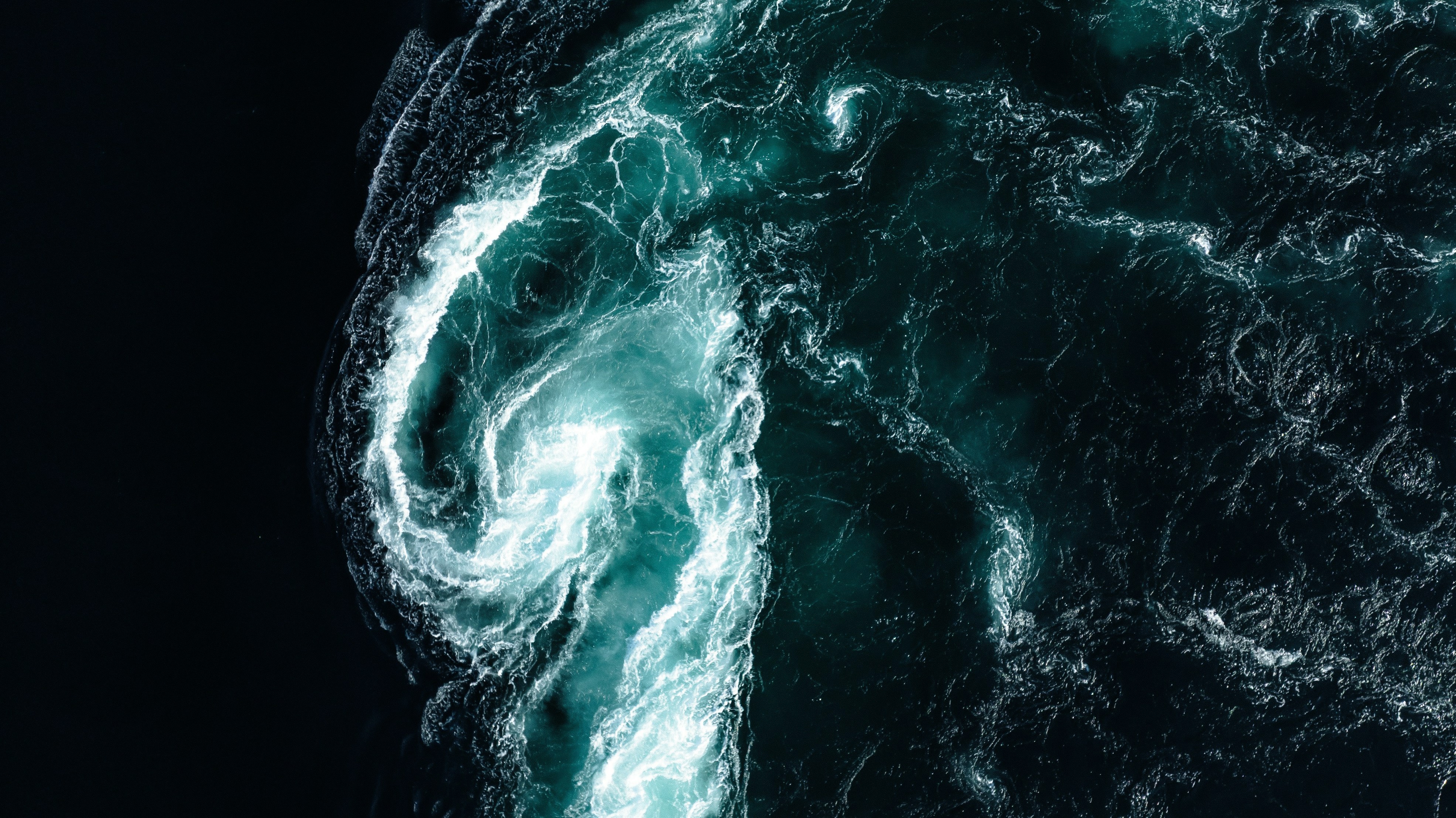
Six Thousand Fathoms by Daniel R Satherley
Tuesday. Just another Tuesday.
I began my routine checks at the Guam tsunami outpost, a solitary monitoring station perched at the edge of the Pacific. A relatively new facility at the very edge of the island, the moment you walked outside, you could smell the salt from the ocean itself.
The facility required only one oceanographer on site, which meant the days passed in silence. Lonely, yes—but at first, that loneliness had felt like relief.
This place buys you time to look back on everything in life, your career and relationships, all the important little things in life that get swept under the rug in the wake of progress.
I was always a nice, quiet guy, as most people who know me would agree. I'd only had a few girlfriends, and they would always complain that I wasn’t outgoing enough.
Trying to get me out of my comfort zone was almost impossible, but what can I say, I love a good book and a quiet library, and adventures that only happened in books.
But as I grew older, I realised that you only have one shot at life, and life is out there waiting.
I remember my childhood, always loving the sea and being fascinated with its creatures hiding in its depths. It was another world to me, and my Father brought me posters of sea creatures to hang in my room.
Then came the day my father disappeared.
There was no note, no explanation; it came as a shock to us, leaving just me to comfort my grieving mother and her ocean of tears that came night after night.
He was an honest man as true as the day was long, and still my hero.
This was my epiphany: I'm going to go find him.
I needed to know what happened.
I had taken up my position at the outpost a few weeks after his disappearance. All I knew about it was that Dad’s body had not been found yet, which was both a blessing and a concern.
No wreckage.
Just a boat, a heading, and the Pacific swallowing the rest.
I told myself this assignment was practical: research hours, field credibility, distance from unanswered questions.
If he had drifted far enough west, I would know.
Four months in, halfway through my paper, he had not turned up—and the days had begun to stretch thin.
The morning checks were monotonous but necessary.
Pressure sensors barely fluctuated.
Seismic and tidal data held steady.
Satellite feeds showed nothing but calm water and passing vessels; everything was normal, and everything needed to be logged.
I activated the hydrophones and listened.
The ocean spoke in familiar ways—distant tectonic groans, the muffled signatures of far-off earthquakes, the hollow thrum of ships crossing shipping lanes.
Nothing out of place. Satisfied, I left the console and made a cup of coffee.
It was mediocre, but warm.
When I returned, I scanned the satellite feeds again. Still nothing. Not even my father, I still spent time every day scanning for reports on his whereabouts.
I reset the hydrophones and settled back into my book.
A few pages later, I heard it.
A low-pitched hum bled through the speakers, deep and steady. At first, I assumed it was seismic—T-waves. They could sound almost vocal at times. I documented it as a low-magnitude tectonic adjustment and continued listening.
The sound did not fade.
Minutes passed.
Ten. Fifteen.
The hum sustained itself, unbroken, its frequency distorted in a way that made my skin prickle. It wasn’t the rolling rumble of rock under pressure. It was too constant. Too deliberate. Beneath the tone, there was a rhythm—not mechanical, not random. Almost like breathing.
I leaned back from the console and rubbed my eyes.
Fatigue could do strange things to perception.
Standing, I moved to the adjoining room and splashed cold water on my face. The mirror reflected someone tired and hollow-eyed, a man I didn’t bother lying to.
I dried my face and returned to the station.
When I checked the hydrophones again, the hum was gone.
Relief came faster than it should have. I told myself it had been a transient seismic event—nothing more. The ocean was vast, noisy, and imperfectly understood. Strange signatures happened. That was the logic I clung to as I logged the absence and pushed my chair back from the console.
Four months into a six-month posting. Keep your eyes on the road.
Even though I knew I was at my limits, I wondered if there was more waiting for me out here?
I buried the sound beneath routine and paperwork and forced it from my thoughts.
For the following two days, the station remained quiet.
Sensors behaved.
The ocean returned to its familiar, indifferent murmur. I slept better than I expected, though I woke each morning with the faint impression that something was left unfinished, a feeling I couldn’t quite grasp.
At 3:00 a.m. on the third night, I woke without knowing why.
The station was dark, lit only by the glow of standby panels.
I moved on instinct, my eyes still heavy and bare feet against cold flooring, my body carrying me to the control room before my mind caught up.
I powered up the hydrophones.
The hum returned instantly. My eyes shot wide open.
Stronger this time. Deeper.
The sound filled the room, steady and invasive, vibrating through the desk and into my chest. I stared at the waveform as it scrolled across the display.
The pattern wasn’t random. It rose and fell with subtle regularity, a slow, deliberate pulse that drew my focus inward.
I documented the start time with shaking hands.
Minutes passed. Thirty, maybe more. The sound did not vary, did not weaken. I felt myself slipping into it, my breathing unconsciously matching the rhythm. Thoughts thinned. The room seemed distant, unreal, as if I were listening from the bottom of a well.
The realisation startled me enough to break the spell.
I shut the hydrophones off.
The silence that followed was abrupt and disorienting.
My heart hammered as if I had been running.
I sat there for a long moment, staring at the darkened display. This was something beyond a delusion.
No lack of sleep or isolation could dream this up. This felt too real.
I returned to bed. I knew I would be far from sleep as this was going to be a long night.
The next morning, coffee in hand, I approached the console with an unease I didn’t want to acknowledge. My fingers hovered over the controls before I activated the hydrophones.
Nothing.
Only the soft, layered sounds of the ocean: distant ships, deep currents, the low static hiss of water under pressure.
Beautiful.
Ordinary.
I exhaled slowly, embarrassed by the tightness in my chest.
This would be hard to explain. It felt like I had done something wrong.
I logged the clean readings and told myself the matter was closed.
Even as I wrote, I found myself listening—waiting—for something to begin again.
The alarms began mid-morning.
I was halfway through reviewing my draft paper when the control room erupted in sound—sharp, insistent tones that cut straight through thought.
Coffee sloshed over the rim of my mug as I frantically crossed the room in two strides.
Pressure sensors were climbing.
Not drifting. Not spiking. Climbing steadily, as if something beneath the station had decided to rise. I pulled up the Mariana Trench array, my pulse quickening as the numbers refreshed.
CTD sensors showed an increase in water temperature at depth—slight, but unmistakable.
That wasn’t possible.
Eleven thousand metres below the surface, the water temperature didn’t change. Not like this. Not without consequence. The pressure that far down would be over a thousand times that of sea-level.
I brought up the live satellite feed.
The ocean above the trench looked calm at first glance, a smooth sheet of blue under clear skies. Then I noticed the birds—dozens of them—lifting from the water in chaotic spirals, fleeing in every direction at once.
I switched screens.
Tidal readings showed mass displacement originating from the abyssal zone.
The deepest part of the ocean was moving.
Pressure continued to rise, each update confirming the last.
Turbidity sensors flared as dense sediment clouds billowed upward, as if the seafloor itself had been disturbed.
My first thought was an earthquake.
It was the only explanation that fit—until it didn’t.
Seismometers registered vibrations equivalent to a magnitude-five event, but the pattern was wrong. There were no precursors. No aftershocks.
The energy wasn’t propagating through rock—it was concentrated, localised, repeating at regular intervals.
Five minutes passed. Then ten.
The pressure kept climbing.
I stared at the data, my mind racing to catch up.
Multiple seismic-scale releases spaced evenly apart.
Temperature rising.
Sediment in motion. Gas signatures are beginning to register at depth.
It was as if several earthquakes were occurring at once, stacked vertically in the water column.
I wiped my palms on my trousers and nervously reached for the hydrophones.
My hand hesitated, then I thought.
"This is your adventure now, calm yourself”.
I took a breath and forced myself to pause. Panic would not help.
Confusion would not lead to answers. Whatever this was, it was still data—still something that could be understood.
I checked the satellite feed again.
There were no surface waves yet, no visible rupture.
Whatever was happening below had not announced itself to the world above. Not yet.
I turned on the hydrophones.
The hum flooded the room.
It was louder than before, its intensity pressing against my ears.
The waveform surged across the display—large, swelling crests followed by tapering decay, repeating with grim consistency.
This wasn’t mechanical. It wasn’t tectonic. The sound was arrhythmic, organic, like a failing lung struggling to draw breath.
Then it stopped.
Abruptly. Completely.
The alarms fell silent.
Pressure readings stabilised. Temperature increases plateaued.
One by one, the systems returned to baseline, leaving the control room unnaturally still.
I sat back in my chair, the echo of the hum lingering in my skull long after the speakers went quiet.
What was that?
I waited. Thirty minutes passed without further activity. No aftershocks. No renewed pressure spikes. The ocean, according to every instrument it had, had simply… settled.
A sudden stop, how?
I began drafting the report.
Deep Trench Event
Date: 28 May 2032
Location: Western Pacific Ocean, Mariana Trench
Depth: 9,120–11,000 metres
Duration: 7 minutes
Energy: Equivalent to a 5.5–6.5 magnitude seismic event
Conclusion:
Mass movement of unknown origin localised within the abyssal zone. No fault correlation. No preceding seismic activity.
End of Report.
I stared at the final line longer than the rest.
I couldn’t deny the facts any longer—not even to myself.
Satellite feeds showed the first signs of surface impact: dead fish floating in widening clusters above the site. Sea level readings indicated a localised rise of nearly three metres.
Gas bubbles began breaking the surface, one after another, as if the ocean were exhaling something it had held too long.
I monitored the site for another hour. The water temperature remained elevated. The gas emissions increased.
Everything was functioning perfectly, no malfunctions, no system errors.
That, more than anything else, terrified me.
I needed another mind on this—someone to tell me I wasn’t misreading the data, or worse, losing my grip on it.
I poured myself a glass of water, steadying my hands as I drank.
Then I reached for the phone.
I dialled my colleague and Geologist Richard Phillips and waited, pacing the control room as the call rang out over the open Pacific.
He answered on the fourth ring.
“Alec,” he said, sounding tired. “How’s life at the edge of the world?”
“Not great,” I replied. “Richard, I need you to listen to me—really listen. I just witnessed something, and I need a second opinion before I start doubting my own head.”
There was a pause. “All right,” he said. “Go on.”
I described the event from the beginning. The hum. Its disappearance and return. The pressure spike, the rising temperatures, the sediment clouds. I read him my report word for word. He let me speak without interruption, offering only the occasional quiet acknowledgement to let me know he was still there.
When I finished, the line went silent.
“Richard?” I asked.
“I’m here,” he said at last. “I’m just…taking it in.
Tell me—has there been any seismic activity since?”
“None,” I replied. “It’s been over an hour. No aftershocks. Nothing.”
“That’s the problem,” he said. “What you’re describing sounds like a deep-focused event with no known fault correlation. Earthquakes leave signatures. They echo. This didn’t.”
I glanced at the screens around me. “The air pressure around the site has risen. Gas exchanges are breaking the surface.
Dead fish are floating in clusters. The satellite feed confirms all of it.”
Richard exhaled slowly. “That almost sounds like a mass of the Earth itself displacing upward,” he said. “But even that doesn’t explain the regularity. The scale is wrong. The pattern is wrong.”
“I know,” I said. “That’s what’s scaring me. I’m struggling for answers and straining my brain to find logic.
“Let’s slow down,” he said gently. “Are you familiar with Occam’s Razor?”
“Entities should not be multiplied beyond necessity.”
“Exactly,” he said. “Let’s not invent monsters where geology will suffice. Especially in a place like that.”
I leaned against the console, watching gas bubbles rupture the surface on the live feed. “Richard,” I said, “have you ever seen anything like this?”
Another pause—longer this time.
“I’ve seen strange things out there,” he admitted. “Enough to know when not to dig too deeply. Do you remember two years ago, when three nuclear submarines went missing near the trench?”
My stomach tightened. “Of course I do.”
“No wreckage.
No debris.
No explanation that ever made it past classified,” he said. “The truth is, Alec, some things vanish, and the world keeps moving. Governments move on. Science files it away. That’s how it survives.”
“And what are you saying?” I asked.
“I’m saying don’t go down the rabbit hole,” he replied.
“Because I don’t know what’s down there—and neither do you. Your superiors won’t thank you for answers they can’t use. Sometimes the most logical decision is to stop looking.”
I said nothing, “Alec, trust me, I’ve been to that outpost and sat in the exact same chair you’re in.”
“Promise me you’ll be careful,” Richard added. “You’re isolated, tired, and sitting alone with too much data. That’s a dangerous combination. If you need me, I’m here all right.”
“I hear you,” I said, though the words felt hollow.
We ended the call soon after. I remained standing long after the line went dead, his warning echoing louder in my mind than the hum ever had.
I turned back to the satellite feeds.
At first, I didn’t understand what I was seeing.
Then the surface elevation model refreshed, and a shadow displaced the light across open water—not a wave, not a swell. A mass.
Something vast is moving just beneath the surface, warping the ocean around it.
My mouth went dry. My pulse hammered in my ears.
Richard had been right. I had reached the edge of something I was never meant to see.
And yet, standing there in the glow of the monitors, I knew with perfect clarity that I could not turn away.
Not now.
I didn’t tell anyone what I was about to do; this was my adventure.
The decision felt less like a choice and more like a correction. One road led to discovery and truth, the other to safety and fear.
I grabbed the keys to the SeaKing helicopter and moved through the outpost on autopilot, the low hum whispering at the edge of my hearing—imagined, I told myself, but persistent all the same.
The rotors began their slow rotation, vibrations travelling up through the frame and into my bones. I pulled on my headset, sealed the canopy, and lifted off from the pad.
As the station fell away beneath me, the Pacific stretched outward in every direction, smooth and blue, betraying nothing of what churned below.
I climbed to five hundred metres, then higher.
From above, the ocean looked peaceful—unbroken, unscarred. No rupture. No wound.
If I hadn’t seen the data myself, I might have believed nothing was wrong. I levelled out at a thousand feet and pushed the nose forward, settling into a steady two hundred and forty kilometres an hour.
The trench lay three hundred kilometres ahead. With a full fuel tank, the flight would be routine.
Half an hour passed.
The helicopter’s engine thrum filled the cabin, but beneath it—faint, insidious—I heard the hum again.
It threaded itself through the noise, burrowing slowly into my thoughts. I shook my head, adjusted my headset, and checked the instruments. Everything was normal. Visibility was good. Winds were within tolerance.
Then the air began to change.
As I approached the site, the wind strengthened abruptly, striking the helicopter from conflicting directions. The controls grew sluggish, the engine strained, and I found myself compensating constantly just to maintain heading. I descended cautiously.
Below me, the ocean was no longer calm.
Gas bubbles roiled at the surface in widening clusters, far larger than anything I had seen on the satellite feed. The water bulged upward, not as a wave but as a displacement, as if something enormous were pressing against it from beneath.
Within moments, the waves doubled in size. Columns of water burst upward without warning, forcing me to climb again to avoid being dragged down.
The pressure in the cabin shifted. My ears popped. The helicopter shuddered.
For a fleeting moment, I wondered if Richard had been right—if this was simply a piece of the Earth forcing its way upward. But the thought didn’t hold. My eyes were locked on the dark shape below, its outline growing clearer by the second.
The surface domed outward.
Then it broke.
The mass that emerged from the ocean eclipsed the horizon, blotting out sky and sea alike. Black armour—plate upon plate—rose dripping from the depths, water cascading off it in endless sheets. I couldn’t speak.
Couldn’t think. The scale of it crushed language out of me.
The helicopter lurched violently, snapping me back to myself.
Warning lights flared across the console. Over the roar of the wind and engine, I heard only the hum—no longer distant, no longer subtle, but resonating from the creature itself.
It was deafening.
I descended without fully understanding why.
The thing lay partially submerged now, motionless, its immense form slack and broken.
As I drew closer, details resolved through the haze of disbelief: puncture wounds gouged deep into its torso, a massive gash torn across its width. Whatever it was, it had lost a fight.
That realisation should have terrified me.
Instead, I laughed.
The sound burst from me without warning, uncontrollable, bubbling up as if it were the most natural response in the world.
Tears blurred my vision as I guided the helicopter down, drawn toward the corpse as though it were calling to me.
The hum pulsed stronger.
I touched down on its surface, the skids scraping against black, scale-like armour that felt warm beneath them. My hand shook as I powered down the engine.
Silence fell—true silence—except for the vibration thrumming up through my feet.
It filled me.
I stepped out onto the creature. The air was thick, acrid, heavy with gas that burned my lungs and made my head swim.
The horizon curved unnaturally around the mass, bending space itself. I felt light, detached, wonderfully calm.
The hum vibrated through my boots, my legs, my chest. Each pulse carried warmth, reassurance, something like understanding. My thoughts softened, unravelled, until holding onto them felt unnecessary.
I sat down. My mind fading. I began swaying side to side at one with the hum.
Laughter overtook me again as the ocean beside us began to swell, as a second beast began rising out of the ocean and still, I laughed.
END.