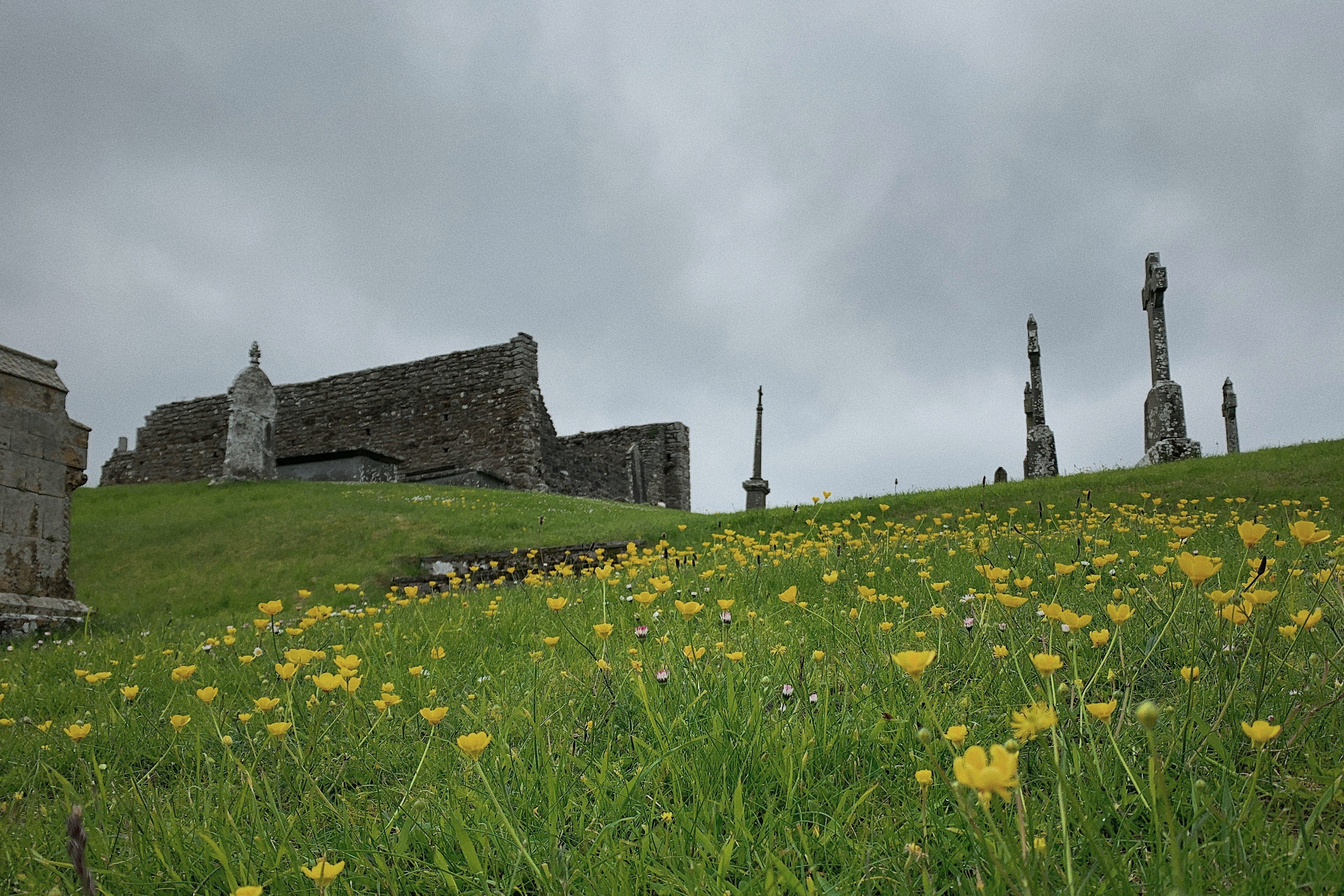
Guaire’s fear was slander,
And she feared the poets two,
For they came to visit him
To scorn him and make demands
Demands he could not meet.
Yet Marbán’s gift was to satisfy
Even the most outlandish want,
For she, Guaire’s sister, was the great swineherd,
That queen who ever kept her brother safe,
She, Marbán the pig prophetess,
Chief messenger of heaven.
Yet, Senchán was to be the ollam, the next poet king –
And his friend, his second – so it was his right to visit all homes
And make demands, and he insisted on having his pound of flesh –
This he swore. His wanted meat: Guaire’s broken honour as a host,
But in his efforts, he abused his power, which prove a catalyst,
The trigger-point of a sundering none would ever willing seek –
for the pair of them had planned to make dear Guaire blush,
for he boasted all too frequently of being spared their satire’s touch,
but they could not embarrass Guaire, he their host, no matter,
for Marbán helped him meet each and all of their demands
so the poets efforts’ and their wants grew prideful and unfair –
So, in overreach, Senchán did doubt
That which, when given freely, it is a sin to slander,
And when he called into question Guaire’s hospitality,
This abuse fast drove the pig-queen into a rage,
And when Senchán did not know the story she demanded –
for Marbán could demand a bard sing for her,
at any time – as heaven’s messenger, she had that right –
and she could choose which story, too,
and so when she called Senchán to sing
she begged him to do so of Ireland’s bravest hound,
a tale she knew neither he or his second ever learned
for it had been forgotten, despite the promised fame
long ago apportioned to the mighty boy
he, who killed three dogs at nightfall
with but a hurley and sliotair trí –
And when Senchán could not speak or sing,
Or usher in a vision of Cú Chullain’s fate,
His failure drew a curse from Marbán’s lips
That changed Ireland evermore,
And when the bardic line it fell,
As her invocation ensured it must,
The Holymost did come,
You, our Christian King on high.
For in her rage and fury, Marbán laid a curse to split and separate
All those who kept the Senchas Már – all those who read and wrote its laws –
And so her hex, it barred all poets in the land, and all who accompanied them,
Of sharing anything at all, so no two poets could even share a roof,
They could not share a bed or draught of beer, on pain of death,
And the ban, she said, it would stand forever and a day,
Unless Senchán could sing Cú Chullain’s then forgotten doom,
And poor Marbán, how she later wept
– oh her tears new rivers formed –
For she did not realise how powerful was the curse,
And in Ireland, her ban, it broke the poet’s rule forever.
And though later the pair of poets learned
Cú Chullain’s long and storied song,
Having sought and found its meaning –
they found it in a graveyard of which the annals speak,
and it was from dead mac Róich’s precious lips they learned it,
for, once wakened, he gladly told Cú’s secret,
for he was Fergus, the stallion’s son, the Ulster king and brave,
who clambered through the deathmuck of his grave
to try and lift the curse and save his land and people;
Fergus, whose last act came sanctioned by great Lír himself;
Fergus, who lifted his own corpse from his grave to sing,
Fergus, who gave unto Ireland even his last contentment –
for he was, until then, beyond the pains and closing ravishes of death –
that slow body-murder of mealworms, he for centuries had felt,
their mouthparts grinding cellulose from bone – it a shearing pain;
and he had been beyond, too, even the conquest of seeds
that found in him a reservoir to fuel their young and thirsty needs
a reservoir to fuel their growth so they might one-day touch the sun –
and yet, he the horse lord hero of Leitir Ruad and many battles more,
he rose again, knowing he would, in doing so, endure death again,
oh bold Fergus mac Róich, he rose again, and to an audience of weary two
he sang Setanta-hound’s great elegy, he sang it gladly to the world again –
But it was not enough, for when the pig-queen’s curse was lifted,
The air had changed and a new age come,
And with that change, the company of bards was broken, too,
And ever more, each poet sang alone,
For together they would only ever argue
And the poet’s reign, now mourned, was done.
Bio
Irish poet, doctoral candidate, and journalist, Oisín Breen, a multiple Best of the Net nominee and Erbacce Prize finalist, is published in 121 journals in 22 countries, including in Agenda, North Dakota Quarterly, Books Ireland, Door is a Jar, Northern Gravy, Quadrant, Southword, and The Tahoma Literary Review. Breen has two collections, the widely reviewed and highly praised Lilies on the Deathbed of Étaín, a Scotsman poetry book-of-the-year, 2023, (Downingfield), and his well-received debut, Flowers, All Sorts, in Blossom, Figs, Berries, and Fruits Forgotten (Dreich, 2020). Breen’s third collection, The Kergyma, is slated for 2025 (Salmon).
Twitter: @Breen
Bluesky: @oisinbreen.bsky.social
Mastodon: @Breen@mastodon.ie
Breen on the Poets & Writers Directory
Full breakdown of published poetry – 230 poems, 22 countries, 121 journals, 3 books.
Full list of journal publications – Already Published – (Creative only, includes fiction & poetry):
About Place, La Piccioletta Barca, Books Ireland, North Dakota Quarterly, Northern Gravy, the Seattle Star, Modern Literature, Drunk Monkeys, Dreich, New English Review, Metaworker, Mono, Crow of Minerva, the Madrigal, Black Poppy, Permeable Barrier, Visual Verse, Meniscus Australia, In Parentheses, Kairos, Discretionary Love, Loch Raven Review, The Gyroscope Review, The Saltbush Review, the Banyon Review, Phantom Kangaroo, Griffel, Door is a Jar, Gaia Literary Review, New Note, Cathexis North West, Wingless Dreamer, Yellerzine, ShabdAaweg, Stepaway, Roadrunner Review, Nevermore, The Belfast Review, Free State Review, Ground Up, Inklette, Euphony, Interim, Roi Fainéant, Thieving Magpie, MIROnline, Sibyl, New Critique, Reservoir Road, Decomp, Grub Street, WRFL, New Feathers Anthology, Oxford Middle East Review, Lucent Dreaming, Heartwood, Universe, Fiery Scribe, Zvona i Nari, October Hill, Red Ogre, Poetica, Drawn to the Light, Stratford Quarterly, the Blue Nib, Kamena, Amphora Magazine, the Kleksograph, Riverbed Review, the Unbound Brooklyn Journal, Mortal Mag, Genuine Gold, Postscript, the Ocotillo Review, the Bosphorus Review, Book of Matches, The Tahoma Literary Review, Crowvus, Expanded Field, Revolute, Aji, Griffel, Seventh Quarry, Camas, the Martello, Inverted Syntax, Active Muse, Sunday Mornings at the River, Soundings East, Consilience, New Plains Review, the Elevation Review, Milk House, Pangyrus, Spectra, Rock & Sling, Thimble, the Exacting Clam, Nether, Lotus Eater, Agenda, Crest, Coffin Bell, Punt Volat, Amphibian, Twenty-Two-Twenty-Eight, and the anthologies An Áitiúil, Across the Margins, Crowstep, Poetry Wales, Coalition for Digital Narratives, Autumn Noir, Penned Poetry for Parkinson's Research, and Spirit of Fire and Dust.
Forthcoming journal publications (Creative only):
Pinhole Poetry, Quadrant, Abstract, NōD, Galway Review, The Ogham Stone, Southword, and The Belfast Review.
Author's note
Carmina’s interest in epic-style poems, in re-telling, and re-imagining is precisely what caught my eye when I was looking for a home for “An Tromdámh Guaire – a (re)telling,” as such pieces are hard to find the right place for, especially in the current zeitgeist, so, frankly, when I saw the call-out, I was quite delighted, feeling the piece had a perfect match off the bat.
The long and the short of it is, I’d like to imagine that my retelling of An Tromdámh sits squarely in the way in which I, as an Irish man, am a part of the continuance of our tradition, our stories, and our meaning, a tradition that goes back before recorded history and includes wonderful narratives like the earliest kept versions of the An Tromdámh. I have, in the spirit of such tradition, both retold it in my own language, but also changed it, tweaked it, and added new aspects, for instance actually tying the hubris of Guaire directly with the changeover in religious culture in Ireland. Of course, we could go line by line and minutae by minutae, but suffice to say, I believe I have both honoured the work, and spun it anew, especially around poor Fergus Mac Róich, a truly heroic character, who I hope in (I apologise) adding somewhat to his torment by spooling out his return to tell the story of Cú Chullain, I have given an extra dimension to the sheer heroism, after all his deeds were done, to brave renewed torment to share again the story of the great hound himself, né Setanta.
I should add, that this sort of work, in general, often informs my practice, with each of my books (Flowers, All Sorts in Blossom, Figs, Berries & Fruits Forgotten, and Lilies on the Deathbed of Étaín) informed and hopefully retelling well aspects of mythology as they are woven into wider pieces and palimpsests. Indeed, Lilies, my second collection leans more heavily on this than the first, with its title piece, in many ways a contemporary reevaluation of Tochmarc Étaín, or The Wooing of Étaín. Equally, my third work, forthcoming from Salmon Poetry, The Kerygma, from which this piece is adapted, is a single epic poem (and I mean epic, 55,000 words) that leans heavily into other Irish mythology to hopefully forge something truly unusual.