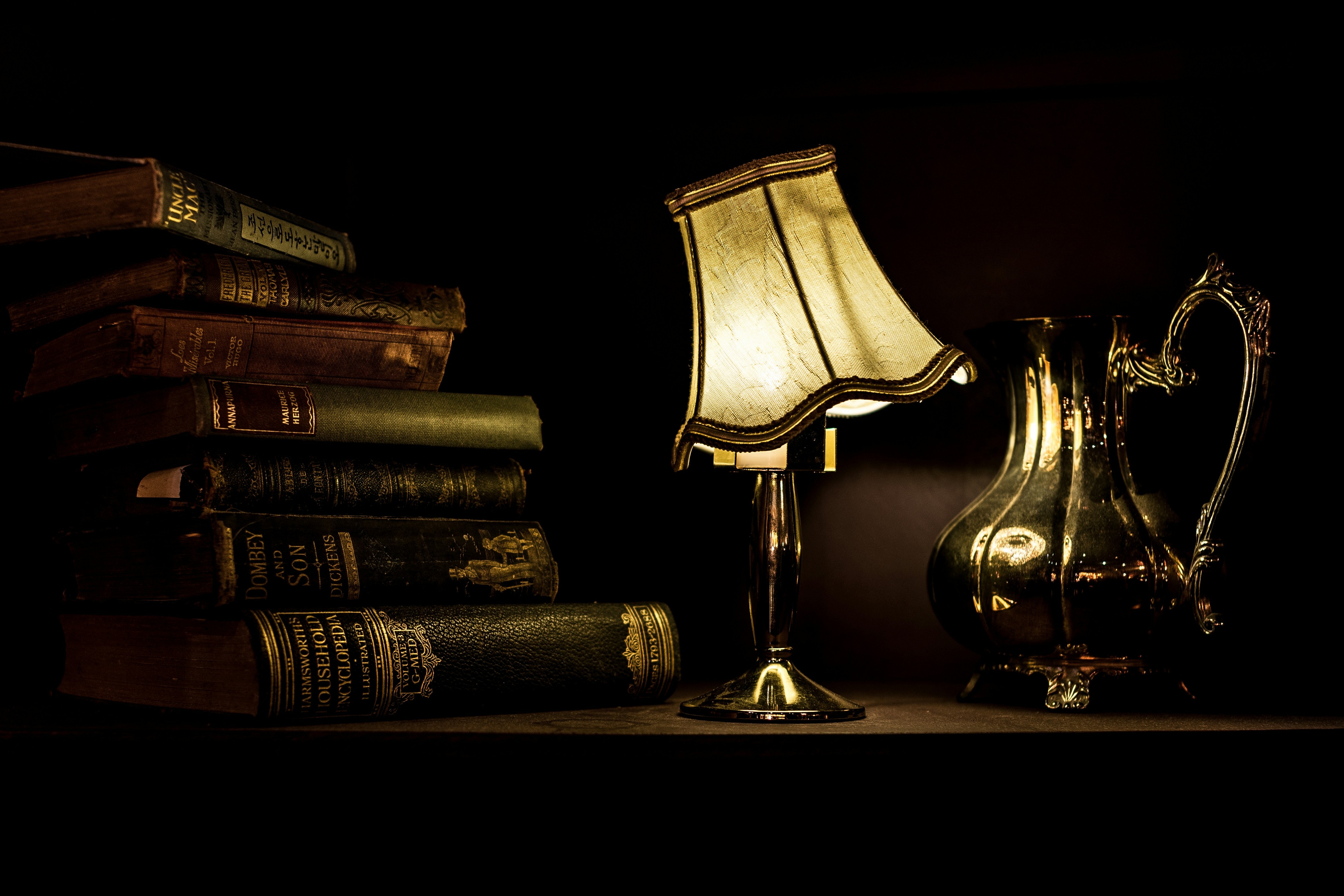
Beauty in the Lap of Horror by Lisa Vincent
As dictated by her captor’s written instructions, Annabel arrived at the threshold of the library a full five minutes before eight o’clock in the evening.
The second hand on the old Louis XIV grandfather clock bounced along its infinite arc as she waited, sending ticks and tocks echoing throughout the hall. The three-story walls, formerly fortresses packed end-to-end with books that muffled all sound, that protected her from the whispers of the house staff, now stood as pocked and barren casualties of war. Many of the books had been removed, and the remaining seemed to provide nothing more than scaffolding. She shook at the obvious change in her circumstances; not only with fear but anger. He had transformed her sanctuary into a battlefield. Her resolve strengthened into a plate of armor about her heart and breast.
The lord of the manor sat before the massive fireplace with an open book on his lap, his gaze fixed on the flames. She continued her sentry at the threshold, waiting. Her freshly washed hair hung in wet ringlets about her shoulders, droplets falling from them like petals from a daisy. He loves me; he loves me not. She needn’t wait for her hair to dry; the final verdict was clear. Her skin was warm now but would soon chill from the drove of drafts dancing through the halls. She kept steadfast in her vigil, however, hiding her impatience, knowing her distress would provoke little to no sympathy from him.
“Enter,” he said, exactly as the last chime of the hour rang out, motioning with a nonchalant wave as his attention remained fixed on the sparks ascending through the flue on their journey into the night sky. She plod barefoot across the ancient stone floor and stood before him as he sat in one of the two weathered chairs, the breath of the fire caressing her backside.
If the library was the heart of the castle, this nook was the seat of it.
He conducted his business and completed any correspondence from a nearby small writing desk. Most of their evenings were spent in the sitting area, dining, reading, and discussing their respective books. The duties of her servitude were discharged here as well, the nature of which both set her both above and beneath the others in his employ.
It was also where they’d first met.
She’d returned home from a suffragette rally to find a messenger dressed in old-fashioned livery standing at the door. According to the man, her father had been arrested while visiting a colleague in Keswick and would be held indefinitely. Without changing clothes or packing a bag, she immediately hailed a cab to the station and purchased a ticket for the next train north. She'd arrived in the Lake District at daybreak with a stiff neck, crumpled sash, and bad temper. After disembarking, she’d hired a carriage, and directed the driver to the address listed on the calling card the messenger had left with her.
Older manors like this one dotted the countryside, but while most had been refurbished with paneled walls and the less austere furnishings popular since Edward’s coronation, crossing this threshold at the butler’s direction was like stepping back in time. Though the décor was largely influenced by Kings Louis XIV, XV, and XVI, the feel was more medieval castle than country home. Composer Charles Avison once described the area as beauty lying in the lap of horror; she thought perhaps this home was its reverse. Though it was nearly mid-day, she followed the illumination of the butler’s candelabra through the worn-stone corridors.
However uninviting the entrance hall, stepping into the library felt like entering the gates of heaven. She’d always had more faith in science than religion, but as she found herself surrounded on all sides by the jewel-toned, leather-bound books of the lord’s private collection, she was willing to acknowledge at least the possibility of a higher being.
“Please be seated, mademoiselle,” the butler said in a thick french accent. “I will notify his lordship of your presence.”
Annabel had taken a seat at the reference table in the room’s center just long enough for the man to leave before springing up and darting to the nearest bookshelf. Like a magnet, her hand was drawn to a ruby and gold-covered edition of Forster’s A Room with a View, one of her best-loved stories. Her fingers tingled as she caressed the spine, and she couldn’t resist the urge to hold it, manners be damned. She hesitated a moment before opening it to the inside cover, glancing left and right to confirm she was still alone. As she started reading, the sounds of Mozart and scent of recently-bloomed violets filled the air. She grinned and swung round to look for the source of the effects. She could find nothing. Annabelle often felt like she’d stepped into the worlds of books when reading, but this was beyond anything she’d ever experienced. Surely she had imagined it.
She clasped onto a nearby copy of A Little Princess, and opened it. The results were the same. The air was filled with the sounds of young girls chattering amidst the scent of ashes.
“I’ll be damned.” She turned toward the voice that had echoed her own thoughts and quickly snapped the book shut again. She had been transfixed by the library’s magic, but the man’s presence reminded her of why she’d come.
“Yes sir, you will,” she began, grounding herself where she stood, hands to hips. “if you don’t release my father at once.”
He laughed. He then walked over to her, closer than etiquette allowed. She gasped as he took hold of her Women’s Political Union sash, and trailed his fingers along the length of it
. “I’m afraid I can’t do that,” he said, taking a respectful step back.
“And why not?” she asked.
“Because,” he said, “your father stole from me and now he must pay penance.”
“You’re lying. My father is not a thief,” she’d said. “What exactly are you accusing him of taking?”
At her question, he’d merely pointed to a glass-encased rose placed in the center of the mantelpiece.
“You can’t be serious,” she said, “it’s the twentieth century. People are no longer imprisoned for such trivial things.” But even as she spoke, she realized her error. The furnishings, his manner of dress, the book that came to life at her touch; she suspected they existed in a time and space that operated separately from her own.
“What is this place?” she asked.
“Come now,” he replied. He motioned toward the first book she’d retrieved from the shelves. “You are obviously a bibliophile much like myself. You must know of the old gods, the old tales.”
“But that is all they are, my lord. Stories, fairy tales.”
With a flick of his wrist over the open pages of A Room with a View, a posie of lilacs materialized in his grip. He made to hand the flowers off to her, but the bouquet dropped in the distance separating them as her attention turned towards the two guards entering the library with her father in tow.
“Papa,” she cried, and ran to him. She embraced him, and then pulled away to check his injuries. His face had several lacerations, and he girded his ribs as if they were the most fragile of bone china. “Oh Papa, what have you done?”
“I knew how upset you were,” her father said. “I wanted to make amends.”
After a few moments, the details emerged. A single pink rose. Her favorite. A gift from father to daughter, picked from the estate garden on the way back to the station.
How she wished she could erase the memory of her contemptuous behavior at her father’s departure. Their lives would be different now if she’d only bid him a good journey instead of throwing a tantrum like a petulant child.
“The train to Oxford leaves at two and one half past,” the lord said to her, as if the broken man who slouched before them didn’t exist. “Say your farewells, and my man will fetch you a carriage.”
“But what will become of him?” Annabel approached the man. “Please, my lord, is there nothing that can be done to secure his freedom?”
“And what, pray tell,” he said to her, his voice booming and ricocheting off of the wood and stone of the room. “Would be as valuable your father’s life?”
“Mine,” she said.
It’d been a simple choice: her father, a lifelong scholar, would be forced to spend the last of his days working the land when the sun was high, and sleeping in a rat-infested dungeon after it set. Or she could serve the time in his stead as a companion to Himself in the lap of luxury – her own rooms, a lady’s maid, an armoire with a never-ending selection of frocks and gowns. And, of course, a library of books she could not read in two lifetimes.
“I have one stipulation,” her father stated that evening from his seat at the formal dining table, the light of the fire flicking across his ashen face. With his eyes fixated on the incriminating rose the lord had centered on the table before dinner, he cleared his brandy-coated throat and continued. “She is to remain chaste for one more year. Until she comes of age.”
The lord nodded and motioned for Annabel to add the clause to the contract she was drawing up while the men drank their digestives.
Her cheeks matched the heat of the flames behind her as she wrote the blush-inducing words. When the last was written, the men had shaken hands as gentlemen. Then the lord placed her hand into his, and before she or her father could sense his intent, drew his side scabbard across her palm. There was a moment of chaos as both she and her father cried out – she in pain, he in ire – until the man dipped his quill into the well of blood pooling in her hand and signed the paper. He then handed the pen to her father, who signed next. Her signature was the last to be added.
As a final step, he retrieved the rose and drew it across the wound until every drop was absorbed, and every petal stained red. Afterward, he returned the flower to its vessel, sealing their bond.
Annabel and the lord spent that first year learning how to maneuver around each other until eventually settling into a predictable if not comfortable routine. They spent their days in the library, she reading the magical books one-by-one, he working; their evenings were dedicated to debating over politics and prose.
When they finally lay together, he confessed that before setting eyes on her, he’d had no intention of letting her father go. As more progressive movements took hold across the country and threatened even his own lands, he sought to keep control of the manor by maintaining the old laws. But then he’d seen her, standing in awe as she discovered her magic for the first time, and knew he couldn’t let her leave.
“My magic?” she’d said, pointing to herself. “But the books; that’s all your doing.”
“No, my dear,” he said, wrapping her in his arms. “It’s all you.”
“Then why was I never able to perform as such before my arrival?” Despite her query, she felt somehow that the words he spoke were true.
“The old magic cannot exist in the new world,” he said, whispering in her ear. “But here, on these grounds, within these walls, the old ways are maintained.”
He then proceeded to explain that his own form of sorcery, naturakinesis, revolved around nature – the elements and weather; the flora and fauna – while hers obviously involved the written word. A unique and rare form of logomancy that allowed her to enter the worlds created by others. As they practiced their gifts, and learned new ones, they would feed the lines that ran underneath and strengthen each other.
“Be warned, however,” he’d said, his tone serious. “Magic always has a price. Make sure whatever you wish to conjure is worth it.”
Now the beast looked up, meeting his eyes with hers, his normally heather-gray eyes turned the same black as his obsidian locks.
“Is there anything you’d like to say to me?” he asked.
She knew what was expected of her – an apology – but hesitated nonetheless. They were both aware of the truth lay between them; she regretted nothing. But for her plan to proceed, she needed free range of the library, and so she acquiesced.
“My apologies, my lord,” she said, breaking eye contact in deference to his pride. “I shall not betray your trust again.”
He said nothing. The awkward silences she’d believed were long behind them had returned. She stood until her eyes glazed over, and her shoulders slumped from the shame of his incessant stare. When she felt like she couldn’t endure another moment, he took both of her hands into his with a gentleness that both surprised and repulsed her. He grazed his lips over the raw skin of her fingertips. She gasped. In an instant, the cuts and splinters that had marred them healed at the touch of his kiss, absolving her sins.
“Good girl,” he said, breaking the silence, his condescension covering her in a film of disgust. “You may proceed.”
It took her a moment to realize what he was asking, but then it dawned on her. A comb had been retrieved from her dressing table and set on the hearth. He motioned toward the worn animal-skin rug laid square to the hearth, awaiting her performance.
With some hesitation, she took her seat on the musky fur, tucked her feet beneath her, and began the work of drying her hair. Wafts of lavender and sage filled the small space of their nook as her fingers tossed the russet tendrils about, layer by layer. She wished for it to be over; her arms were tired from the travails of her time in the tower and she was failing at all attempts to ignore the feel of his eyes boring into her. She wanted to run but the potential rewards of seeing her plan to fruition kept her on task. The longer they sat, performer and patron, the higher the flames leaped, until at last a stray flame lapped at her thigh, singeing the shift and burning her recently scrubbed skin.
His chuckle, a deep rumbling, the sound of Apollo’s chariot chasing the darkness across the sky, echoed throughout the cavernous room. Soon enough the fire settled, withdrawing its seeking tongue.
Annabel continued her ministrations, combing the damp rivulets into manageable strands before weaving them into a simple plait held in place by a ribbon. She rose, fetched a shawl from the vacant chair next to his, and walked behind him to the bookshelves reserved for novels and poetry collections.
“What shall it be tonight, my dear?” he asked. “A story of rogues and damsels in distress? A Russian fairy tale? The Bard’s Sonnets?”
“Perhaps,” she said, rolling the ladder from the back of the room to where the fiction section began. “I hadn’t yet considered it.”
“I am having a difficult time believing that is so,” he said, his fingers tapping a tattoo on the chair’s arm.
Of course it was a lie; she always came prepared. She maintained a running list of books she’d love to abscond with — The Count of Monte Cristo, Macbeth, Anna Karenina — whatever was required to attain her freedom and by any means. Escape. Murder. Suicide. Alas, she’d never seen such titles in here. If he was in possession of them, she assumed they were locked in one of the many locations forbidden to her. She’d long ago resigned herself to stories that gave her temporary escape – through wardrobes that led to perpetual winter landscapes or nighttime flights to worlds of pixies and pirates – and usually had a sense of which one might suit her mood long before sunset.
“Or maybe you’ll be tempted by tales recounting the misadventures of impudent imps and scoundrels, then?” he said with a sneer. “You seem to be drawn by such, as I recall…”
She winced at his remark. Dickens. It surprised her it had taken him this long to reference her indiscretion.
A messenger had arrived a fortnight ago, asking to see Annabel. After reading the telegram sent by her father’s caretaker, she’d been desperate to leave. To see her Papa once more before the illness took him.
“I must visit him at once,” she said across the tea-table where they ate their meal. He’d been holding her hand, but released it at her words. Their rose began to wilt from atop the mantelpiece. “My Lord, what is it?”
“That was not part of the agreement, my dear,” he said. “I’m afraid I can’t allow it.”
She broke down, begged, but he would not budge. That was the moment the rose began to die.
For a full night and day, she had mentally sorted through the entirety of the collection in hopes of lighting upon one that, if manipulated just right, would help her to return home. At the height of the lord’s trust in her, at the pinnacle of any pity he was capable of feeling, he agreed to let her take Oliver Twist back to her rooms.
The next day, she opened the book and was transported to the streets of London, where she observed the characters in action, obsessing over every detail until she came upon a possible solution. Near midnight, she tucked the book into her reticule, and donned a traveling coat, turning the cuffs back halfway up her arm. With the tales of the young orphan in her possession, she was able to artfully dodge the guards and all other protections the lord had placed on the manse. She knew she’d been discovered, however, when the snow began at her first step past the main entrance. Despite her quickened pace, the drifts were knee-height by the time she’d made it to the barnyard gate. The lord sat upon the steed he’d gifted her just beyond.
“Did you think me so daft?” he said.
She approached him, as skittish as his gelding. “Sir, yours is a brilliant mind,” she said in a reproachful tone. “I only wished to see my father.”
“Nonsense,” he said. “You stopped having a father the day you surrendered yourself to me.” He grabbed her arm and slung her over the withers before him.
They returned to the library, where he extinguished the fire and forced her to kneel on the frigid stone for the rest of the night and into the next evening. At this point, the guards dragged her to the tower that had been furnished with only a worn-down mattress and a light coverlet.
In the midst of winter, the nights lasted an eternity and the solitude and darkness left her vulnerable to her own mind. In the daylight, the boredom threatened her sanity even more so. Her fingertips became raw from the pawing and scraping of them against the massive wooden door seeking escape; splinters replaced skin after the first few days.
Thrice a day she was granted short moments of respite; like the caged animal she’d become, she waited for her feeder to deliver trays of day-old bread and sour milk. Her existence had been whittled down to the barest of necessities – food, shelter, sleep. His goal must have been to break her, to make her more pliable and certainly more agreeable. Instead, as dear Mr. Dickens wrote, “he stole her heart away and put ice in its place.”
When not sleeping or reading, she spent hours scheming, drawing strength from her suffragette sisters who were also incarcerated, in jails and asylums, by the men from whom they demanded independence.
Before daybreak that morning, the guard’s knock woke her. She followed him back to her rooms, where she collapsed into the arms of her lady’s maid. The woman, middle-aged, a bit rotund and soft, cradled her until she calmed. She then poured Annabel a cup of tea, and held the chipped cup against her lips, coaxing her to nurse from it.
“My father?” she asked, bracing herself, afraid of the answer she might receive. “Have you heard any news?”
“A messenger came yesterday,” she said, clutching Annabel closer. “He is very ill, but still alive.”
She still had time. Annabel could hold her tears no longer and sobbed like a babe as the maid cooed and rocked her.
“We need never be ashamed of our tears,” the woman said, wiping a stray drop. When Annabel didn’t respond, she gripped the young woman’s chin and held it up.
“We need never be ashamed of our tears,” she repeated, sounding out each word. “Understand?”
And in an instant, Annabel did. She knew well the famous quote from Great Expectations.
There was but one problem. Now that she’d betrayed him, the lord would not allow her to borrow even the safest seeming volumes. She’d have to be conscientious with her time – she could neither rush nor dawdle in her search.
She climbed to the top shelf and lingered over the first row, stroking her nails along Austen’s collection before taking hold of Pride and Prejudice.
That wouldn’t do; that wouldn’t do at all.
She slipped the book back into its empty slot and stepped two rungs lower.
She was met there by the Bronte sisters. She eased the cover of Wuthering Heights open and felt...nothing. The story’s themes already matched her situation too perfectly.
She sighed.
As her time was quickly dwindling, she dropped to the floor to peruse the next bookcase.
There it was. Great Expectations. At the sight of it, her heart beat in rhythm with his incessant drumming of the armchair. She pulled the book from the shelf and heard a thump. Behind it, she found a second smaller book that was charred on the edges and quite old.
Beowulf; the original beast-slayer.
The left side of her mouth formed a half-smile. What a treasure indeed. Her father’s favorite, the one he delighted in reciting at every opportunity: when they had guests, during holidays, or on cold, dark, mid-winter evenings when they needed a diversion. As a child she’d jump from her seat on the hearth and act out the battle scenes in cadence with his words – “He twisted in pain, And the bleeding sinews deep in his shoulder Snapped, muscle and bone split And broke,” – wielding an invisible version of Grendel’s gory limb with, as her father described, “the finesse of a natural-born sabreuse.”
She traced the title with her fingertips and felt the force of its energy begin to replenish her reserves. Before she had the opportunity to open the tome, it flipped open to a passage someone had earmarked. She knew it well.
“That shepherd of evil, guardian of crime, Knew at once that nowhere on earth Had he met a man whose hands were harder...”
As she lay her hands on the book, a mother’s hand on a babe, the paper became rigid beneath her touch.
Her hand shook as it covered the page. Could she do this? Did she have the strength? With a quick turn towards the mantel, the sight of the blackening rose confirmed the truth of the matter – a part of her, the part he’d conjured through hunger and isolation and torture, was positive that she could, that she did. He may have had the ability to control nature, but somehow during her incarceration, she’d become something unnatural, and their bond was breaking.
She removed the dagger from between the pages, the image of a bloody arm etched into its ivory handle, and returned to the monster’s lair.
“You’ve chosen then,” he said, his gaze still fixed on the fire.
“Indeed,” she said, “I have.”