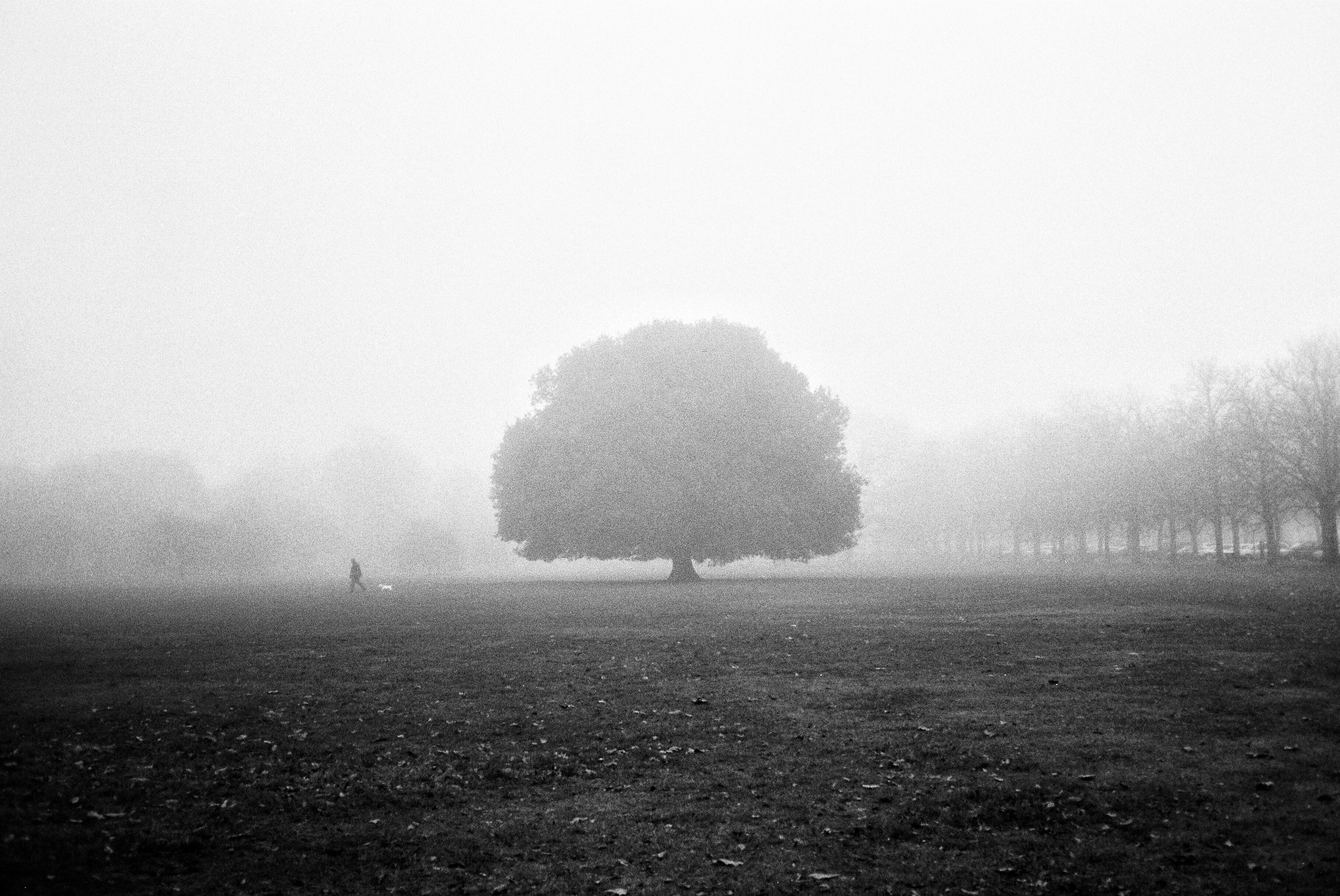
Photo by Tomás Robertson on Unsplash
Yggdrasil by Tim Hanson
One week after the old man had moved into his new house, lightning struck.
The ash tree in his front yard had been a hallmark of our neighborhood, dating back decades before the old Swede had moved in, but his brooding suggested it was a pain only he endured. We understood, though: he’d purchased a house that looked like every other around it, the only distinguishing features being that gorgeous ash and the treasures hanging from its branches. The family before him had created and hung nine bird feeders during their tenure here, each crafted to look like a castle from the children’s favorite fantasy stories, and they were marvels to behold. However, the old man cared not for the feeders the Harrisons had left behind, nor did he pick up their shattered remains intermixed with all that other broken wood. He simply sat himself down on a section of the fractured trunk, shook his head, and stared mournfully at what remained of his beautiful tree. From sun up to sun down, he held daily vigils in his front yard while doing absolutely nothing to remove the mess causing him this heartache—just one more thing he did that irritated the ever-loving hell out of us.
On the Neighborhood app, where we gossiped about those not signed up for the app, we’d often discussed the old man even before the ash’s demise. We’d all gone out of our way to welcome him, exchanging small talk and offering our homes for a welcome-to-the-neighborhood dinner, but he’d gruffly declined each invitation, choosing instead to spend his evenings alone on the front porch, staring wistfully at that tree while drinking his tea (probably spiked with whiskey, some speculated). So it wasn’t as if we’d driven the old man to this solitude or that we didn’t understand how great of a loss the tree was or that we didn’t try to help; he just refused our every effort, and with each passing day, we had to bear witness to his brooding. And our patience was growing thin.
Two weeks had passed, and the corpse of that once-great ash remained exactly where it had fallen.
The first to approach the old man about the tree was Kevin Fitz, a middle-aged accountant who’d moved in eight years earlier. In the kindest terms, under the most sympathetic auspices, he encouraged the old man to hire a removal company and recommended one his brother owned (he’d even put in a good word and get the old man a discount). Kevin was only seconds into his pitch when the old Swede barked, “How ‘bout you mind your own goddamn business. It’s my tree, not yours, so I don’t see how it’s any of your concern.” Kevin held up his hands, like a man caught in the crosshairs of an assassin, and said, “No harm meant, old fella. Just tryin’ to help.”
Which is what Kevin recounted to us on the app that afternoon, saying it’d be a cold day in Hell before that old bastard cleaned up his mess.
And that’s when those who’d been thinking of putting their houses up for sale began speaking their minds, decrying the old geezer and accusing him of being lazy and unconscionable. “Who will want to buy our house with that goddamn tree just lying there!” his next-door neighbor, Edith Hill, asked. “Doesn’t he realize what he’s doing to us, how he’s ruining our lives!” her husband replied in all capitals. Whether he heard these complaints or not, it didn’t matter: the old man kept walking out each morning to take a seat on that fallen tree, and anyone who dared ask him what was wrong was met with the most caustic reply.
“That tree’s been there for three weeks!”
“Is he ever going to clean it up!”
“I miss the Harrisons. They would’ve cleaned up that tree weeks ago!”
The entire neighborhood rallied against the old man, casting him as the villain in their daily lives. It was easy to pluck problems from their jobs and their marriages and blame him for these, too. No one stepped forward to denounce these accusations or point out the errors of our ways, and why should they? We all had jobs, we all were being flayed by our bosses and called out for our short-comings; why the hell should we care one iota about an old man sitting on a dead tree? Why should we expend the effort to push past his gruff exterior when he did absolutely nothing to connect with us? He was so close to the end, after all; why waste the effort to make a connection and try to solve this unsolvable problem?
And then Bryan Anderson’s eight-year-old son approached the old man.
Four weeks after lightning had killed his precious tree, little Tommy Anderson walked up to the old Swede.
“Hi!” the boy yelled, stutter-stepped, and then meekly added: “Um. How are you?”
The old man had received numerous such calls; however, despite rejecting them all, he now accepted this one with a smile. “I’m okay. How are you, son?”
From all accounts, both those derived from Tommy’s retellings and from those who didn’t even hear the exchange, the boy never wavered in his pursuit to get to the bottom of the matter. “I’m good, sir. I just wanted to ask…um, I mean, if it’s okay to ask…why do you keep sitting on that dead tree every day?”
We all had our hypotheses, but what the boy learned didn’t coincide with anything we’d envisioned. “This tree…it meant a lot to me.”
“Why?”
The old man considered this, combed a hand through his gray beard, and smiled. “‘Why’ is the most important question you can ask. Keep asking it, son; can’t go wrong with digging deeper beneath the surface.”
“What?”
The old man shook his head. “Nothing. Just something I used to tell my own boy when he asked that question. What is it you really want to ask me, son?”
We’d all wanted to ask the old man why he sat there every day, why he wept over a tree he’d only owned a month, why he was such an asshole to us. The boy only asked the first question, though. The old Swede considered it carefully, looked wistfully around the neighborhood, and said, “Can you tell me what your most important place is?”
“The Pizza Palace!” Tommy said immediately, referring to a run-down pizza parlor downtown.
The old man smiled even wider at the boy’s enthusiasm. “And why is that?”
“Because I had my last birthday there! It was so much fun! The best birthday party ever!”
The old man laughed, a sound so foreign from those ancient lips that Tommy took a step back, until the sound eventually made a similar one stutter from his own mouth. “Um, Mister, but what I want to know…um, why do you care so much about this tree? I mean…I know lightning hit it, and it was a really pretty tree, everyone thought so, but…why do you care so much?”
The old man didn’t yell at the boy, but he did grow serious, his smile falling into stern concentration. “You know that place you love so much, The Pizza Place—”
“The Pizza Palace,” Tommy corrected, and winced, perhaps fearing admonishment for being rude.
He received no such rebuke. “Of course. I should remember that. My own family ate there a few times—”
“But I thought you just moved in.”
“No. I just moved back,” the old man corrected. “My family and I, we lived here a long time ago. Long before most of the people in this neighborhood lived here. Even then, this tree stood tall. It didn’t have fancy bird feeders then—we did have a cheap plastic thing my cousin got us for Christmas, but nothing like what the previous family left—but it did have a tire swing….”
The old man grew silent, opened his mouth as if to say more, then closed it, before pressing a tight fist to his lips. Tommy knew this look; most boys who grew up in the Midwest would, boys who’d heard those tall tales about how “real men” don’t cry: the old man was fighting back tears. This may have been the only time Tommy rethought starting this conversation, that maybe bidding the old man adieu to allow him a moment’s sob would be the kindest action, but then the old man regained his composure, cleared his throat, and continued: “It did have a tire swing. I’d gotten the tire downtown at a friend’s garage, told him it was for my boy, not a car, and he gave me a good deal. He also gave me a length of rope to tie it from the strongest branch. And there it hung….”
Again, the old man stopped, but rather than feeling it proper to walk away and let the man cry alone, Tommy stepped closer. He suddenly understood what none of us did: that whether it was preceded by a gruff reply or a choked silence, the old man needed to say these words, needed to get these stories out of his head and into the air, into reality, to people who could hear them and carry them on and retell them to others after the old man had passed. History and religion only exist because people retold these tales, even though they’d never been there to experience them firsthand. So the boy would stay as long as needed: to listen; to respond; and then to retell.
“You remind me of him,” the old man whispered.
“Who?”
The old man wiped his eyes. “My son. I pushed him every day out here. When my days at work were bad. When his days at school were even worse. When the world reminded us, time and again, that cruelty reigned supreme, I pushed him, and oh, how he laughed. And when my wife got home from work and saw us here, she’d run over and join us, and no matter what she had also endured that day, she held us in her arms…and there was nothing better. A senseless world made sense; the unkindness of it all instantly melted in that embrace….”
The tears finally fell and wouldn’t relent, and the boy fought the urge to hug the old man (if only because when he’d broken down in the past, he was embarrassed to have it acknowledged by anyone but his mother). “Mister….”
The old man waved a hand, wiped his eyes, and cleared his throat. “No, no. It’s okay.” He stared at the broken ash again, looked skyward, and then bowed his head. “I can still hear their laughter.”
Another sigh, another large breath, and then: “He died five years ago.”
Tommy’s eyes widened. “How?”
The old man just shook his head again. “Car accident. Freak occurrence. Heavy rain and a screech of the tires and….”
And with that description, the old man would share no more.
“Life after you lose a child is just biding time,” the old man eventually said. “Time for you to look back, to think of the good times, those moments when life wasn’t dominated by so much cruelty.” A late summer wind, interrupting autumn’s gradual decline to winter, threaded its fingers through the boy’s and old man’s hair, and both inhaled its intoxicating scent. “They call this farewell summer.”
“Who do? What’s farewell summer?”
“Never mind,” the old man said, and he dared to smile again, even if just a little. “I could blame my digressions on my old age—old fools love to digress—but it’s been a habit since I first learned to speak. What can I say? I love a good digression.” The old man patted a spot next to him on the broken trunk. “If I stick to the point, more or less, would you sit with me a spell so I can tell you this tree’s story properly?”
The old man’s tale was long, and although he promised to stick to the point, digressions frequently interrupted it. That was okay, though, because Tommy soon realized all the digressions, all those slices-of-life caught up in the story’s telling, they, too, were part of the story, the reason why, after watching his wife slowly die the last two years (“Cancer. An unfair sentence passed on a saint”), the old man had bought this house again and returned to the mythical land that held so many tales, so many things to be revered.
“It’s a crazy idea, and I knew it even before I put ink to paper, but a part of me, I think, was expecting to step back in time. It’s why Christians travel to Bethlehem; it’s why we visit the graves of those we love; it’s why people fight over lands made sacred to them by their sacred texts. The land becomes holy. It gets caught up in our history, in who we are.
“When that lighting hit…it did more than bring down a tree that had given us such a good life, that had become a symbol of everything worth living for…it became just another reminder in the temporariness of it all, a tough lesson for an old man simply asking for the echoes of a great life and not the great life itself.”
The old man went on like that, bouncing back and forth until he was back right where he’d started: here, on a broken tree trunk, alone.
But not alone. Somewhere in the middle of the old man’s tale, Tommy had begun crafting a new one, based on and borrowing from elements he had extracted from the history of this mythical tree. “We have a tree, too.”
The old man looked away from the carnage and into the boy’s eyes, and what he saw there made him smile: it was the look of imagination, firing on all cylinders and working for the forces of good. “Is that so, son? What kind of tree?”
The boy cast his mind back but discovered his parents had never named it. Actually, they rarely spoke of it, except to complain about its leaves getting in the gutters. “I don’t know. But it’s big. Not as big as yours was, but it could hold me.” And then he added, in a voice so soft and meek it was a marvel the old man could hear it: “It could also hold a tire and a rope, I think.”
The old man said nothing, his face betrayed nothing, and the boy feared he’d been presumptuous with his suggestion, perhaps even blasphemous. That is, until the old man’s eyes filled with tears again and a smile so large it looked painful removed decades from the old man’s face. “Who’d push you, son? If I may ask.”
The young boy giggled, excited to answer a question he knew the old man already knew the answer to. “Well, you’d push me. I mean, if you wanted to.”
The old Swede laughed at that, not because what Tommy had said was funny but because to hear such wonderful fantasy after so much misery, well, it had to be a joke. But it wasn’t. And the old man knew it wasn’t.
“I’d love to, son,” he whispered. “I’d love to.”
The old man didn’t become a modern-day Ebenezer Scrooge after that, regaling all of his neighbors with jovial greetings and armloads of gifts. He was still gruff, cantankerous, and hesitant to share more than the obligatory “hello” with anyone (except for the boy and eventually the boy’s family), but the black cloud that had arrived with the old man’s arrival, that had perhaps produced the lightning that had shattered his mythical tree, dissipated as that year gave birth to the next. Early that spring, as promised, Tommy got his father to hang a tire from their tree, while the old man stood nearby with a cup of tea and recounted the same stories to Bryan Anderson that he had to his son the previous autumn. Bryan took an instant liking to the old Swede—“He reminds me so much of my own father”—and it became commonplace to see the family and their adopted grandfather sharing stories and drinks on the Anderson’s front porch.
By this point, the decimated tree had long since been removed from the old man’s yard, and in its place, a young tree had been planted. If the old man isn’t sharing stories with the Andersons, you can usually find him tending that tree. You could even say, “Hello,” if you’d like, but don’t feel too bad if you receive only a curt “hello” in return.